Thursday, 3 May 2012

Aristocracy of the dead

Aristocracy of the dead
The tombs of the rich are often to be admired and marvelled at and then walked past as we consign their memory to temporary oblivion and that is arguably as it should be. The joy of English parish Churches is that there is much that is ordinary and 'in the vernacular'. England doesn’t have much in the cemetery that is showy and brash. That would never do! Instead, England has the sandstone stele monument or the Celtic/Cornish granite headstone that marks the seasons by referencing the moss and gentle decay whilst very slowly mouldering into the soil. On the Continent, it is very different and monuments seem to have surpassed the life of the individual they commemorate. The monument is greater than the man

Just as the venerable Sexton in “Dealings with the Dead” (1856) is clear that there is an aristocracy of the dead, it also clear that the English have maintained a fine and traditional indifference towards monuments and remained, instead, happy to provide either a low monument or no monument at all. The grass and the wildlife seem enough for us as we are gently layered into the ground to await our fate. There are clearly some grand monuments and the one at Saint Remigius at Hethersett is a great favourite of mine as it stands by the edge of the field as if about to escape into the landscape. There are great monuments in Churches and we all recognise the marble plaques about to crush us in their monumentality if they were ever to fall from their walls. They say much and also tell us nothing about the person they commemorate and, in reality, the large plaques aren’t very English at all.


Commemorated in Valetta
© Godric Godricson

Englishness is about recognising wealth, power and privilege and then doing absolutely nothing about it. Englishness is about understanding social prestige and admiring that prestige before going to the supermarket and buying beer for the hot summer we all hope for. It is that in the end we are really quite casual about titles and honours and we are also quite aware that the exteriors doesn’t always match the interior. The grand lady, wrapped in furs,  may be starving from a lack of breakfast and the great lord may have threadbare socks. Not everything is as it seems in this world or the next. The great monument may be built of shoddy materials and the lettering on the stone may be mispelt through ignorance or haste. The English understand these possibilities and naturally sneer at aristocracy whether that aristocracy is in blood, monuments or the grave. It’s all so much flim-flam at the end of the day.

Rural parish Church in North Norfolk
© Godric Godricson
 The tombs of the rich are admired that much is true although the English do not worship long at any one altar and we do not marvel over much at any one tomb. We do not over monumentalise the folly of human lives and we do not often deify the departed. It is hard to worship at a tomb when the occupant of the tomb was as mortal as us and had the same foibles and follies. So, let people have their aristocracy in the grave and have their 30 seconds of adulation as we walk past before we walk away and forget them until the next visit along with the next sunrise.

Private G Butters - Ashill


Private G Butter - Ashill
© Godric Godricson
 

Herbert Harrowven - Ta'braxia Cemetery 1897

Herbert HARROWVEN (son of Thomas  Harrowven)  aged 24 years 9 months, born in Easton, Norfolk, Gunner, 17 Company, E.D.R.A (Eastern District Royal Artillery).

Died of Enteric Fever (Ingestion of food or water contaminated with the feces of an infected person) 17th December 1897 and buried Ta'braxia Cemetery 18th December 1897.

Height : 5 feet  6 ¾ inches tall

Weight : 151 pounds

Religion : C of E

Service
Home :    10th June 1895 – 4th November 1895
Gibraltar: 5th November 1895 – 28th October 1896
Malta :     29th October 1896 – 17th December 1897

Military discipline : Minor infringements in Great Yarmouth, Gibraltar and Malta(Delay in obeying an order, absent from  fatigue duty)


The Bells of Valetta


George William Thurrell 1893 -1917

George William Thurrell
Name: George William Thurrell
Son of Thomas Thurrell (Farmer of Town Farm) and Agnes Thurrell
Birth Place: abt 1893  Holme Hale, Norfolk
Son of William and Agnes Thurrell, of Carleton Rode, Norwich, Norfolk.Native of Holme Hale
Death Date: 27 Aug 1917
Memorial : Tyne Cot Memorial
Rank: Private
Regiment: Northamptonshire Regiment
Battalion: 7th Battalion
Number: 43533
Type of Casualty: Killed in action
Comments: Formerly 2929, Norfolk Yeomanry

Reginald Robert Thurrell 1896 - 1916


Name: Reginald Robert Thurrell
Birth Place: 1896 Holme Hale, Norfolk
Son of Thomas Thurrell (Farmer of Town Farm) and Agnes Thurrell
Death Date: 7 Sep 1916
Burial : Heilly Station Cemetery  Somme
Rank: Private
Regiment: Household Cavalry and Cavalry of the Line (incl. Yeomanry and Imperial Camel Corps)
Battalion: Norfolk Yeomanry
Number: 2930
Theatre of War: Western European Theatre

Expressions of piety


Expressions of piety
© Godric Godricson


Monday, 30 April 2012

Saint Botolph - Banningham

See Saint Botolph at a favourite site
© Godric Godricson

Sophia Ann Goddard - Norwich


Norfolk Annals 1801

“The remains of Miss Sophia Goddard, of the Theatre Royal, Norwich, were interred at St. Peter Mancroft.  Mr. Hindes, the manager, and the principal actors attended on the melancholy occasion.  This young lady had obtained considerable reputation on the Norwich boards, and was making rapid advance to eminence in her profession when death prematurely deprived the theatrical world of an actress whose talents would have ensured her success on any stage.  She supported with great fortitude and resignation a long and painful illness, brought on by exertions that her constitution was unequal to, and died on Sunday last (March 15, 1801), in her 26th year, sincerely beloved and lamented by her family and friends.”

Saints Peter and Paul - Knapton


The Church of Saints Peter and Paul was seen on a warm day in April after the rains had passed. The grass was wet and the bird song was loud. A wonderful day in Norfolk!


© Godric Godricson


The Grateful Dead


"There are cultures that are finely-tuned with all things spiritual; others that relish the protestant work ethic and treat death as a mild inconvenience. And then there are the Maltese. We love everything about death. Here are five reasons for my assertion"


For the full story see this link to "Malta Inside Out"

Friday, 27 April 2012

Hart Island

Hart Island is a subject I came across a few years ago. The idea of a Potter’s Field was new to me. In Europe we don’t tend to segregate the dead by means of financial resources in such a clear and organised manner. Yes, Europe has 'experienced potter's fields' in history and there is an awareness of the ‘best end’ of a cemetery and the ‘cheap seats’. That has always been the way of things. Have a look at Kensal green or Highgate Cemetery and you can see the idea of wealth and privilege in burials. There is always the aristocracy of the dead. The rich and the poor are always segregated in life and also in death. However, in Europe there has always been more integration within one cemetery rather than having two separate cemeteries. There is a wonderful photo essay on the island that I recommend you to read to understand about the island and the atmosphere created.

In the English parish Church, we find that the rich and the poor may be more intimately combined and the layers of burials inter-weave and overlap so that we are all reintegrated over time, no-matter our wealth or status. The South-side and East-end of the Church would always be colonised by the rich although the poor would creep round the corner and the rich are sometimes interred on the North side as the cemetery filled up. In England, there is something of an egalitarian juxtapositioning of the bodies so that we become more of a unity. In the newer Metropolitan (largely secular)  cemeteries from 1855 there is more scope for segregation based on the sheer size of the cemeteries and the tendency not to re-use grave space as was the case in the older and crowded parish cemeteries. The large Municipal cemeteries in the North of England are replete with stone monuments that speak of money, industry and pride although even here the poor could be buried close by and the public grave was usually in the same cemetery rather than being placed elsewhere.

North America has another tradition and that is in the segregation of the rich and the poor into completely separate entities. The Potter’s field is a sort of ‘apartheid’ where the poor are apparently separate but equal. Oh dear and alas for the Republic that preaches equality  only for people to be segregated in death. Hart Island is the largest cemetery in North America and as such it demands our attention and curiosity. Whilst Europe is, to its eternal shame,  the location of huge cemeteries at Auschwitz and other extermination centers; Hart Island is different. Hart island is an example of a gargantuan peace-time cemetery that is based on economic apartheid rather than genocide and mass murder. Hart Island is a cemetery that is based on the uncaring bureaucracy of the City. People live and they die in the City without care and support and they end up discarded with the thinnest veneer of decency. The dead are stacked and warehoused on Hart Island by the hands of the prisoners who represent something of the poor who have always been the inmates of prisons and places of detention.

Am I making a bid for European intellectual superiority? Well no, I’m not making that assertion. Europe, after all, carries the historic burden of so much blood and misery perpetrated against political, sexual, religious and ethnic minorities. Instead, Hart Island represents something of the casual way in which human life comes to an end and the City simply disposes of the dead. The ‘little person’ without family or friends can come to a sticky end and find themselves in an unmarked grave out in the channel. The problem for me is that Hart Island has become something like a cultural and metaphorical  ‘oubliette’ where we forget poor people in "plain sight" of wealth. People are disposed of and ‘deleted from history. Even the records of the dead are uncared for and left to rot and burn as if they had never existed.  

When I first heard of Hart Island I was both appalled and excited in equal measure to find a place that I had never heard of and which seemed both illicit and intriguing. However, the more I read about Hart Island the more it became for me symptomatic of the anonymity of the Western world. We live and we die before being swept away in the morning like so much trash. The beautiful baby that is momentarily caressed in the arms of its mother is cast aside in later  years and is laid to rest like garbage. Hart island is a loathsome and horrid place and somewhere that I expected to find in the genocidal annals of European history rather than in the land of the free.

Melinda Hunt is leading the valiant campaign to re-integrate Hart Island into American consciousness and she leads the Hart island Project. Something you may like to read about


A visit to Hart Island 1978

Thursday, 19 April 2012

Dealing with the dead - 1856

Project Gutenburg

"The board of sextons have met, and we have concluded not to recommend a revival of the ancient custom of burning the dead. It would be very troublesome to do it, out of town, and inconvenient in the city. I have always thought it wrong to bury in the city; and it would be much worse to burn there. The first law of the tenth table of the Romans is in these words—“Let no dead body be interred or burnt within the city.” Something may be got to help pay for a church, by selling tombs below. When a church was built here, some years ago, an eminent physician, one of the proprietors, was consulted and gave his sanction. Yet more than one of our board is very sure, that, on a warm, close Sunday, in the spring, he has snuffed up something that wasn’t particularly orthodox, in that church.

The old Romans were very careful of the rights of their fellows, in this respect: the twelfth law of the tenth table runs thus—“Let no sepulchre be built, or funeral pile raised within sixty feet of any house, without the consent of the owner of that house.” They certainly conducted matters with great propriety, avoiding extravagance and intemperance, as appears by the seventh law of the same table—“Let no slaves be embalmed; let there be no drinking round a dead body; nor any perfumed liquors be poured upon it.” So also the second law—“Let all costliness and excessive waitings be banished from funerals.” The women were so very troublesome upon these occasions, that a special law, the fifth, was made for their government—“Let not the women tear their faces, or disfigure themselves, or make hideous outcries.”
It was not unusual for one person to have several funerals: to prevent this, however agreeable to the Roman undertakers, the tenth law of the tenth table was made—“Let no man have more than one funeral, or more than one bed put under him.” There was also a very strange practice during the first Decemvirate; the friends often abstracted a finger of the deceased, or some part of the body, and performed fresh obsequies, in some other place; erecting there a cenotaph or empty sepulchre, in which they fancied the ghost of the departed took occasional refuge, when wandering about—in case of a sudden shower, perhaps; or being caught out too near daylight.


Jewish Cemetery in King's Lynn, Norfolk
© Godric Godricson

For the correction of this folly, the Decemvirs passed the sixth law of the tenth table—“Let not any part of a dead body be carried away, in order to perform other obsequies for the deceased, unless he died in war, or out of his own country.” It was upon such occasions as these, in which an empty form was observed, and no actual inhumation took place, that the practice  of throwing three handsful of earth originated. This usage was practised also by the Jews, and has come down to modern times. Baron Rothschild (Nathan Meyer) who died in Frankfort, July 28, 1836, was buried in the ground of the Synagogue, in Duke’s Place, London. His sons, Lionel, Anthony, Nathaniel, and Meyer, his brother-in-law, Mr. Montefiore, and his ancient friend, Mr. Samuels, at the age of ninety-six, commenced the service of filling up the grave,—by casting in, each one of them, three handsful of earth. Not satisfied with carrying a bottle of sal volatile to funerals, the women, and even the men, were in the habit of carrying pots of essences, which occasioned the enactment of the eighth law—“Let no crowns, festoons, perfuming pots, or any kind of perfume be carried to funerals.”
Burning or interring was adopted, by the ancients, at the will of the relatives. This is manifest from the eleventh law, which prohibits the use of gold in all obsequies, with a single exception—“Let no gold be used in any obsequies, unless the jaw of the deceased has been tied up with a gold thread. In that case the corpse may be interred or burnt, with the gold thread.” A large quantity of silver is annually buried with the dead. It finds its way up again, however, in the course of time.
Courtesy : Dani Simmonds
Common as burning was, among the ancients, it was looked upon, by some, with great abhorrence. The body to be burned was placed upon a pile—if the body of a person of quality, one or more slaves or captives were burned with it. When not forbidden, all sorts of precious ointments and perfumes were poured upon the corpse. The favourite dogs and horses of the defunct were cast upon the pile. Homer tells us, that four horses, two dogs, and twelve Trojan captives were burnt upon the pile, with the dead body of Patroclus. The corpses, that they might consume the sooner, were covered with the fat of beasts. Some near relative lighted the pile, uttering prayers to Boreas and Zephyrus to increase the flame. The relatives stood around, calling on the deceased, and pouring on libations of wine, with which they finally extinguished the flames, when the pile was well burnt down. They then collected the bones and ashes. How they were ever able to discriminate between men, dogs, and horses, it is hard to say. Probably the whole was sanctified, in their opinion, by juxtaposition. The bones might be distinguished, but not the dust. Such bones as could be identified, were washed and anointed by the nearest relatives. What an office! How custom changes the complexion of such matters! These relics were then placed in urns of wood, stone, earth, silver, or gold, according to the quality of the parties. Where are these memorials now! these myriads of urns! They were deposited in tombs—of which a very perfect account may be found in the description of the street of tombs, at Pompeii."

Sint-Andrieskerk - Antwerp


Saint Andrew’s Church in Antwerp is testimony to a loyalty that withstood the test of time. Although  her remote Jacobite descendant, King Henry IX , was present at the siege of Antwerp in 1746. Queen Mary Stuart of Scotland is still commemorated in this beautiful Antwerp Church. Paid for by her ladies in waiting Barbara Mowbray and Elizabeth Curle, the monument is a small but important ending to the long story and captivity of Queen Mary Stuart.

When I came across the monument I was very much captivated by the story of the ladies making their long flight from the problems of the English protestant Court and making away to the relative peace of the Spanish Netherlands as Belgium was known. The monument is a sort of cultic centre for Mary Stuart on the continent and an example of the monument being inside the Church.

© Godric Godricson
I recently said my prayers both for Queen Mary and for the ladies in waiting amidst the few tourists in the Church. May their loyal souls find repose in the Lord and may the City of Antwerp be rewarded for the haven it gave to the women.

Sunday, 15 April 2012

Nieuw Amsterdams Peil


This is a photograph of mine that featured in a newspaper in The Netherlands

65-jarige Groothof maakt kinder-Matthäus

Foto: Godric Godricson
 
Amsterdam, 14 februariDe vandaag 65 jaar geworden Frank Groothof werkt aan een kindervoorstelling gebaseerd op Bachs Matthäus-Passion. De Amsterdamse acteur en theatermaker maakt al vele jaren bewerkingen van operas, maar wil nu ook het lijdensverhaal voor kinderen ontsluiten. Dat verhaal is behoorlijk gruwelijk: de protagonist, Jezus Christus, wordt aan een kruis genageld.
Het fonds Turing Foundation schreef op zijn website dat het een subsidie ter waarde van 20.000 euro heeft toegekend voor de realisatie van het project. De uitvoeringen gaan begin 2014 van start. Groothof wil dat er een traditie ontstaat om het lijdensverhaal aan kinderen te vertellen. In Nederland vinden er op Goede Vrijdag ieder jaar talloze uitvoeringen van de Matthäus-Passion plaats.  Lees de rest van 65-jarige Groothof maakt kinder-Matthäus

Charles William Jerningham


Norfolk Annals 1820


Died, aged 47, at Dunkirk, Mr. Charles William Jerningham, second son of Sir William Jerningham, of Costessey.  “Mr. Jerningham had served eight camps in the Austrian Army with distinguished valour, being engaged in the great battles of Jemappe and Fleurus, and was several times wounded.”  His remains were interred at Costessey on October 23rd.

Sir William Jerningham - Costessey

Norfolk Annals 1809


Died, at his seat at Costessey, aged 74, Sir William Jerningham, Bart., (“subject to the decision now pending in the House of Lords”) Baron Stafford, of Stafford Castle.  He was succeeded in his title and estate by his eldest son, Mr. George Jerningham, Haughley Park.

Friday, 13 April 2012

Charles Edward Jerningham - Graf Von Jerningham


Courtesy :
Duboix


Born abt.  1727     Died 23rd October 1802


"Died, at Vienna, aged 80, General Jerningham, (Graf Von Jerningham)  nephew of Sir George Jerningham, Bart., of Costessey.  He was upwards of 50 years in the Imperial service, and was Chamberlin to the Empress Maria Theresa and to the Emperors Joseph, Leopold, and Francis".


An appeal for eternal life

Courtesy : lisasolonynko
I want to return to the idea of Jesus being a sort of Osiris for the Western world. There are clear and evident parallels in the return of the vibrant young man to the world of the dead and back again to a celestial paradise. Not an exact Osiris because Jesus as a man was born into the Jewish context and in a specific historical epoch. Osiris was born into an entirely  Egyptian epoch. There can be no exact meeting of accounts and I am not in any way saying that Jesus is Osiris or a sort of pale shadow of the Egyptian. Instead, I’m saying that there is an elective affinity between Jesus and Osiris that will not go away and the more we study the parallels then the more similarities are there and  the more they stand out. The panoply of demi Gods are all there; represented by Anubis and the Gods of the underworld. Anubis is there in the same manner that Christians have the idea of hell and the creatures that wait in judgement along with Saint Peter guarding the gates.

I am most convinced that there is a sort of relationship between the two when we come to the idea of Resurrection and a clear afterlife. Without this metaphor there could have been no Egyptian need for the embalming and entombment of the dead and the Christian would not bury the dead with such care close to Churches and chapels. Both cultures seem to have had a clear and passionate belief in the afterlife based on the inescapable idea of  re-birth and life after death. I can hear Christian theologians explaining the distinct differences between Osiris and Jesus, however, we have to approach this matter in the round rather than becoming tied up on specifics.

Courtesy : Columbia114
Both people were the subject of injustice and both died a violent death. Osiris was cut into pieces and spread around Egypt and Jesus faced a ritual death with bodily fluids flowing from his wounds into the world and into the atmosphere thereby being scattered in a mystical and real way. There is something here about inhumanity and tragedy perpetrated on the Royal individual who becomes King in another place whilst also being a Creator and the guarantor of eternal life. There is something here also about public engagement with the atrocity. It is as if the world is turned upside down in the cruelty and the killing. We are all culpable in the death and share in the sacrifice because we did not collectively take part in trying to stop the injustice. Osiris and Jesus are a real sacrifice and led like a sheep to the slaughter. There is in both deaths the idea that the devil or the forces of evil took part in the death although there is also the idea that there be no other way for both individuals. Both needed to die to have the Resurrection of their bodies although each in their unique manner. Osiris becomes the reformed body held together by bandages and the art of the embalmer and Jesus walks freely amongst his followers although Jesus seems to have had some sort of ‘haze’ around him that protected his identity for a time. We’ll say little about the women involved in the story whether they are mortal or the divine Goddesses of Egypt.

Lazarus from the dead
© Godric Godricson
Jesus and Osiris died or were torn apart at the full moon and this takes us back to an earlier form of calendar when the moon was the main measure of time rather than the sun. The moon is usually an older form of measuring time and cycles and we could  become a little mystical ourselves in this area although I merely wish to lay out some sort of parallel for the involvement of a lunar calendar. Jesus and Osiris are bound in a way by the involvement of the lunar calendar and the way that the calendar is significant in the events of the Resurrection. Modern Christians  still follow the lunar calendar in the celebration of Easter and we often have to consult tables to plan the next years services and readings. Such is the abiding power of the lunar system in the celebration of  death and Resurrection

Courtesy : Kevan
Osiris and Jesus had the power to raise the dead to life. In the parish Churches of the UK we find that the dead are stacked and layered away to await the eternal afterlife that is promised in scripture. Under the floors of the Church and even in the walls our ancestors wait for the promised Resurrection in a manner similar to the ancient Egyptians; who similarly yearned for their own Resurrection to eternal life.

Dealings with the dead - 1856

 
Project Gutenburg
"Throw aside whatever I send you, if you do not like it, as we throw aside the old bones, when making a new grave; and preserve only what you think of any value—with a slight difference—you will publish it, and we shouldn’t. I was so fond of using the thing, which I have now in my hand, when a boy, that my father thought I should never succeed with the mattock and spade—he often shook his head, and said I should never make a sexton. He was mistaken. He was a shrewd old man, and I got many a valuable hint from him. “Abner,” said he to me one day, when he saw me bowing, very obsequiously, to a very old lady, “don’t do so, Abner; old folks are never pleased with such attentions, from people of your profession. They consider all personal approaches, from one of your fraternity, as wholly premature. It brings up unpleasant anticipations.” Father was right; and, when I meet a very old, or feeble, or nervous gentleman, or lady, I always walk fast, and look the other way.
Sextons have greatly improved within the last half century. In old times, they kept up too close an intimacy with young surgeons; and, to keep up their spirits, in cold vaults, they formed too close an alliance with certain evil spirits, such as gin, rum, and brandy. We have greatly improved, as a class, and are destined, I trust, to still greater elevation. A few of us are thinking of getting incorporated. I have read—I read a great deal—I have carried a book, of some sort, in my pocket for fifty years—no profession loses so much time, in mere waiting, as ours—I have read, that the barbers and surgeons of London were incorporated, as one company, in the time of Henry VIII. There is certainly a much closer relation, between the surgeons and sextons, than between the barbers and surgeons, since we put the finishing hand to their work. And as every body is getting incorporated now-a-days, I see no good reason against our being incorporated, as a society of sextons and surgeons. And then our toils and vexations would, in some measure, be solaced, by pleasant meetings and convivial suppers, at which the surgeons would cut up roast turkeys, and the sextons might bury their sorrows. When sextons have no particular digging to do, out of doors, it seems well enough for them to dig in their closets. There is a great amount of information to be gained from books, particularly adapted to their profession, some of which is practical, and some of which, though not of that description, is of a much more profitable character than police reports of rapes and murders, or the histories of family quarrels, or interminable rumors of battles and bloodshed. There is a learned blacksmith; who knows but there may spring up a learned sexton, some of these days.
The dealings with the dead, since the world began, furnish matter for curious speculation. What has seemed meet and right, in one age or nation, has appeared absurd and even monstrous in another. It is also interesting to contemplate the many strange dispositions, which certain individuals have directed to be made, in regard to their poor remains. Men, who seem not to have paid much attention to their souls, have provided, in the most careful and curious manner, for the preservation of their miserable carcasses. It may also furnish matter for legitimate inquiry, how far it may be wise, and prudent, and in good taste, to carry our love of finery into the place, appropriated for all living. Aristocracy among the dead! What a thought. Sumptuary considerations are here involved. The rivalry of the tomb! The pride—not of life—but of death! How frequently have I seen, especially among the Irish, the practice of a species of pious fraud upon the baker and the milk man, whose bills were never to be paid, while all the scrapings of the defunct were bestowed upon the “birril!” The principle is one and the same, when men, in higher walks, put costly monuments over the ashes of their dead, and their effects into the hands of assignees. And then the pageantry and grandiloquence of the epitaph! In the course of fifty years, what outrageous lies I have seen, done in marble! Perhaps I may say something of these matters—perhaps not."

Thursday, 12 April 2012

Fakenham Parish Church


Fakenham, Norfolk
Fakenham Parish Cemetery
© Godric Godricson

The dismal surroundings of the cemetery at Fakenham is typical of much of Anglican cemeteries. The land has been scraped clean of monuments with a small fraction being left to one side as a slight recollection of what was originally there. Oh dear!  I didn't spend much time in the cemetery because of a bunch of rather menacing people lounging in what has become a sad part of the town scape in Fakenham.

To the cemetery!
© Godric Godricson
The sign to the cemetery is peeling and tired and says something about how the Anglican Authorities treat the idea of the faithful departed. If they give such thought to the dead how will they treat the living?

Dealings with the dead - 1856


Project Gutenburg 
Dealings with the Dead
 
 
"This is a very solemn service, when it is properly performed. When I was a youngster, Grossman was Sexton of Trinity Church, and Parker was Bishop. Never were two men better calculated to give the true effect to this service. The Bishop was a very tall, erect person, with a deep, sonorous voice; and, in the earth-to-earth part, Grossman had no rival. I used to think, then, it would be the height of my ambition to fill Grossman’s place, if I should live to be a man. When I was eight years old, I sometimes, though it frightened me half to death, dropped in, as an amateur, when there was a funeral at Trinity.

I am not, on common occasions, in favor of reviving the old way of performing a considerable part of the service, under the church, among the vaults. The women, and feeble, and nervous people will go down, of course; and getting to be buried becomes contagious. It does them no good, if they don’t catch their deaths. But, as things are now managed, the most solemn part of the service is made quite ridiculous. In 1796, I was at a funeral, under Trinity Church. I went below with the mourners. The body was carried into a dimly-lighted vault. I was so small and short, that I could see scarcely anything. But the deep, sepulchral voice of Mr. Parker—he was not Bishop then—filled me with a most delightful horror. I listened and shivered. At length he uttered the words, “earth to earth,” and Grossman, who did his duty, marvellously well, when he was sober, rattled on the coffin a whole[ shovelful of coarse gravel—“ashes to ashes”—another shovelful of gravel—“dust to dust”—another: it seemed as if shovel and all were cast upon the coffin lid. I never forgot it. My way home from school was through Summer Street. Returning often, in short days, after dusk, I have run, at the top of my speed, till I had gotten as far beyond Trinity, as Tommy Russell’s, opposite what now is Kingston Street.

Grantham Parish Church
A great change has taken place, since I became a sexton. I suppose that part of the service is the most solemn, where the body is committed to the ground; and it is clearly a pity, that anything should occur, to lessen the solemnity. As soon as the minister utters the words, “Forasmuch as it hath pleased Almighty God,” &c., the coffin being in the broad aisle, the sexton, now-a-days, steps up to the right of it, and makes ready by stooping down, and picking up a little sand, out of a box or saucer—a few more words, and he takes aim—“earth to earth,” and he fires an insignificant portion of it on to the coffin—“ashes to ashes,” and he fires another volley—“dust to dust,” and he throws the balance, commonly wiping his hand on his sleeve. There is something, insufferably awkward, in the performance. I heard a young sexton say, last week, he had rather bury half the congregation, than go through this comic part. There is some grace, in the action of a farmer, sowing barley; but there is a feeling of embarrassment, in this miserable illustration of casting in the clods upon the dead, which characterizes the performance. The sexton commonly tosses the sand on the coffin, turning his head the other way, and rather downward, as if he were sensible, that he was performing an awkward ceremony. For myself, I am about retiring, and it is of little moment to me. But I hope something better will be thought of. What would poor old Grossman say!"


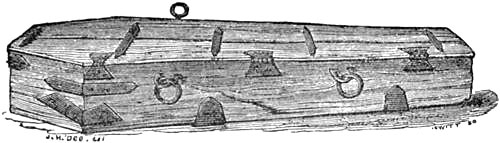
Parish Coffin - Easingwold

PARISH COFFIN, EASINGWOLD CHURCH.


Coffin - Craan

"In Ireland, there was a curious custom of burying the dead without coffins. “Until about the year 1818,” says a correspondent of Notes and Queries, Second Series, vol. i., “certain families, named Tracey, Doyle, and Daly, of the townland of Craan, near Enniscorthy, in the barony of Scarawalsh, in the county of Wexford, were in the habit of burying their dead uncoffined, in the graveyard attached to the Augustinian Abbey of Saint John. The bodies were brought to the place of sepulture in open coffins, with their faces uncovered. The graves were made six or more feet deep, and lined with bright green turf from the banks of the river Slaney. In these green chambers, were strewn moss, dry grass, and flowers, and a pillow of the same supported the head of the corpse when it was laid in its last earthly bed.”

Elizabeth Bulwer - Saint Julian's Norwich


Saint Julian's
monumental
inscriptions

Elizth relict of
Edw'd Bulwer
died May the 10th
1773
aged 84

Thomas Sowter - Saint Julian's Norwich


Saint Julian's
monumental
inscriptions

Sacred to the memory of
Thomas Sowter Gent
Late of this City
who resigned his breath
February 8th 1825
Aged 60 years
Also Mary beloved wife
who departed this life
February 27th 1839

Death is nothing at all


Death is nothing at all

Table Tomb
South Pickenham
© Godric Godricson
 
I have only slipped away into the next room
I am I and you are you
Whatever we were to each other
That we are still
Call me by my old familiar name
Speak to me in the easy way you always used
Put no difference into your tone
Wear no forced air of solemnity or sorrow
Laugh as we always laughed
At the little jokes we always enjoyed together
Play, smile, think of me, pray for me
Let my name be ever the household word that it always was
Let it be spoken without effort
Without the ghost of a shadow in it
Life means all that it ever meant
It is the same as it ever was
There is absolute unbroken continuity
What is death but a negligible accident?
Why should I be out of mind
Because I am out of sight?
I am waiting for you for an interval
Somewhere very near
Just around the corner
All is well.
Nothing is past; nothing is lost
One brief moment and all will be as it was before
How we shall laugh at the trouble of parting when we meet again!

Canon Henry Scott-Holland, 1847-1918

Houghton on the Hill

© Godric Godricson


The graveyard of Houghton on the Hill is in the middle of nowhere and that's the way I like my graveyards.

The graveyard is beautiful both in the snow and in the heat of summer as it reveals wildlife and the sounds of nature. There is a story of the ghost Carthusian Monk who protects the building and a pretty convincing picture of the apparition is on show by the caretaker.