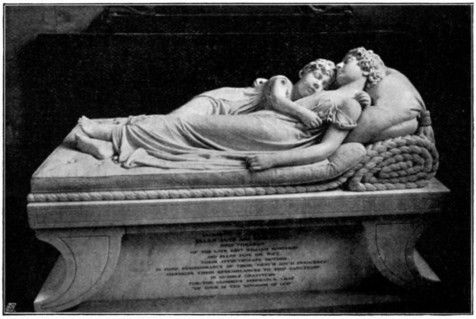
"The monument is in memory of the two daughters of the Reverend William Robinson, Prebendary of the cathedral, and represents the young children locked in each other's arms".
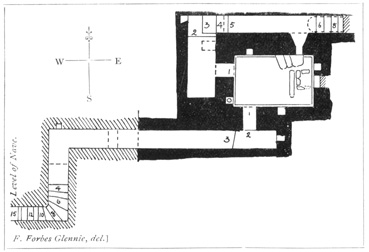
"The Saxon Crypt, sometimes called St. Wilfrid’s Needle.—From a trap-door in the pavement below the piscina a flight of twelve steps winds down into a flat-roofed and descending passage, 2½ feet wide and slightly over 6 feet high, which, running a few feet northwards and bending at right angles round the south-west tower pier, extends eastward for about 10 yards, with a descent of one step near the end, and terminates in a blank wall. There is a square-headed niche at the turn and a round-headed niche at the end, both meant, doubtless, to hold lights. Three feet from the end a round-[72]headed doorway, 2 feet wide and over 6 feet high, opens northwards, with a descent of two more steps, into a barrel-vaulted chamber, 11 feet 5 inches long from east to west, 7 feet 7 inches wide, and 9 feet 10 inches high. In the north wall of this chamber, and approached by three rude steps, is the celebrated St. Wilfrid’s Needle, a round-headed aperture pierced through into a passage that runs behind. This aperture was connected with one of those superstitions that so often flourished before the Reformation in notable centres of religion, and ability to pass through it or ‘thread the needle’ was regarded as a test of female chastity; but it was, of course, in the later middle ages that this superstition arose, and the ‘needle’ (or rather needle’s eye) is evidently only one of the original niches with the back knocked out. Of these niches (which again were doubtless for lights) there are four in the chamber besides the ‘needle,’—one in each wall,—and, like the niche, at the end of the passage of entrance, they all have semicircular heads each cut in a single stone. That in the west wall has a hole or cup at the bottom, probably to hold oil in which a wick might float, while the others (except the ‘needle’) have a sort of funnel at the top, doubtless to catch the soot from lamps. In the east wall there is also a round-headed recess of larger size, the meaning of which will be discussed later. An excavation made in 1900 has lowered the earthen floor and revealed a set-off running round the chamber,and upon the ground at the east end are traces of a later mediæval altar, namely, a long stone parallel with the east wall and having behind it a small rectangular enclosure bounded by other wrought stones. Some of the latter were only laid bare at the above-mentioned excavation, when, moreover, the enclosure was found to be a pit containing bones, some of which had belonged to a man, others to an ox, others to a bird. These were probably regarded as relics, and may have been buried here at the Reformation for safety,but it is possible that they were placed here at an earlier period, and that this is an instance of a relic-pit. Two other deposits have been found in the crypt in modern times, one behind the niche in the south wall of this chamber, the other behind the niche at the end of the passage of entrance. Most of the bones in these deposits were human, but one had belonged to an ox, another to a bird, another to a sheep, while others could not be identified. These bones again were probably ‘relics,’ and had almost certainly been built up behind the niches at the Reformationfor concealment. From the west end of the chamber another doorway similar to the last opens, with an ascent of one step, into a second chamber, 12 feet long from north to south, 4 feet wide, 9 feet high, and roofed with a semi-vault rising eastwards, in which there has been a square opening, probably for ventilation. At the north end a flight of four steps, lighted doubtless from the square niche in the west wall, ascends eastwards to the passage behind the ‘needle.’ Of these steps the lowest occupies the whole width of the chamber, while the second, on being cleaned at the time of the excavation above-mentioned, was found to have its upper and western surfaces sunk in the middle and traversed at one end by two parallel raised bands, and to show traces of that yellow enamel-like substance with which, indeed, the whole crypt seems to have been originally overlaid. In roof, width and height the passage at the top of these steps resembles that by which the crypt was approached, but it is spanned at the entrance by a round arch, and gradually ascends, terminating in a staircase now blocked at the fourth step (or perhaps the fifth, since one seems to have been removed at the bottom), while in the roof may be traced the shape of the long opening (rounded at the western end) through which these stairs once led up into the church. From the point at which they are blocked the distance to the arch that spans the passage is about 18 feet. It will be noticed that the floor of this passage is level with the ‘needle,’ which on this side, moreover, has been broken through so as to open out like a funnel".
The origin of the catacombs of Paris is very interesting, and not known to many. The stone, of which the ancient buildings of Paris were constructed, was procured from quarries, on the banks of the river Bièore. No system had been adopted in the excavation; and, for hundreds of years, the material had been withdrawn, until the danger became manifest. There was a vague impression, that these quarries extended under a large part of the city. In 1774 the notice of the authorities was called to some accidents, connected with the subject. The quarries were then carefully examined, by skilful engineers; and the startling fact clearly established, that the southern parts of Paris were actually undermined, and in danger of destruction. In 1777 a special commission was appointed, to direct such works, as might be necessary. On the very day of its appointment, the necessity became manifest—a house, in the Rue d’Enfer, sunk ninety-two feet. The alarm—the fear of a sudden engulphment—was terrible. Operatives were set at work, to prop the streets, roads, palaces, and churches. The supports, left by the quarriers, without any method or judgment, were insufficient—in some instances, they had given way, and the roof had settled. Great fear was felt for the aqueduct of Arcueil, which supplied the fountains of Paris, and which passed over this ground, for it had already suffered some severe shocks; and it was apprehended, not simply that the fountains would be cut off, but that the torrent would pour itself into these immense caverns. And now the reader will inquire, what relation has this statement to the catacombs? Let us reply.
For hundreds of years, Paris had but one place of interment, the Cemetery des Innocens. This was once a part of the royal domains; it lay without the walls of Paris; and was given, by one of the earlier kings, to the citizens, for a burying-place. It is well known, that this gift to the people was intended to prevent the continuance of the practice, then common in Paris, of burying the dead, in cellars, courts, gardens, streets, and public fields, within the city proper. In 1186 this cemetery was surrounded with a high wall, by Philip Augustus, the forty second king of France. It was soon found insufficient for its purpose; and, in 1218, it was enlarged, by Pierre de Nemours, Bishop of Paris. Generation after generation was deposited there, stratum super stratum, until the surrounding parishes, in the fifteenth century, began to complain of the evil, as an insufferable nuisance. Such a colossal mass of putrescence produced discomfort and disease. Hichnesse speaks of several holes about Paris, of great size and depth, in which dead bodies were deposited, and left uncovered, till one tier was filled, and then covered with a layer of earth, and so on, to the top. He says these holes were cleared, once in thirty or forty years, and the bones deposited, in what was called “le grand charnier des Innocens;” this was an arched gallery, surrounding the great cemetery.
With what affectionate respect we cherish the venerated name of François Pontraci! Magnum et venerabile nomen! He was the last—the last of the grave-diggers of le grand charnier des Innocens! In the days of my novitiate, I believed in the mathematical dictum, which teaches, that two things cannot occupy the same place, at the same time. But that dictum appears incredible, while contemplating the operations of Pontraci. He was a most accomplished stevedore in his department—the Napoleon of the charnel house, the very king of spades. All difficulties vanished, before his magic power. Nothing roused his indignation so much, as the suggestion, that a cemetery was full—c’est impossible! was his eternal reply. To use the terms of another of the fine arts, the touch of Pontraci was irresistible—his handling masterly—his grouping unsurpassed—and his fore-shortening altogether his own. Condense! that word alone explained the mystery of his great success. Knapsacks are often thrown aside, en route, in the execution of rapid movements. In the grand march of death, Pontraci considered coffins an encumbrance. Those wooden surtouts he thought well enough for parade, but worse than useless, on a march. He had a poor opinion of an artist, who could not find room, for twenty citizens, heads and heels, in one common grave. Madame Pontraci now and then complained, that the fuel communicated a problematical flavor to the meat, while roasting—“c’est odeur, qui a rapport à une profession particulière, madame,” was the reply of Pontraci. The register, kept by this eminent man, shows, that, in thirty years, he had deposited, in this cemetery, ninety thousand bodies. It was calculated, that twelve hundred thousand had been buried there, since the time of Philip Augustus. In 1805, the Archbishop of Paris, under a resolve of the Council of State, issued a decree, that the great cemetery should be suppressed and evacuated. It was resolved to convert it into a market place. The happy thought of converting the quarries into catacombs fortunately occurred, at that period, to M. Lenoie, lieutenant general of police. Thus a receptacle was, at once, provided for the immense mass of human remains, to be removed from the Cemetery des Innocens. A portion of the quarries, lying under the Plaine de Mont Souris, was assigned, for this purpose. A house was purchased with the ground adjoining, on the old road to Orleans. It had, at one time, belonged to Isouard, a robber, who had infested that neighborhood. A flight of seventy-seven steps was made, from the house down into the quarries; and a well sunk to the bottom, down which the bones were to be thrown. Workmen were employed, in constructing pillars tosustain the roof, and in walling round the part, designed for le charnier. The catacombs were then consecrated, with all imaginable pomp.
In the meantime, the vast work of removing the remains went forward, night and day, suspended, only, when the hot weather rendered it unsafe to proceed. The nocturnal scenes were very impressive. A strange resurrection, to be sure! Bonfires burnt brightly amid the gloom. Torches threw an unearthly glare around, and illuminated these dealings with the dead. The operatives, moving about in silence, bearing broken crosses, and coffins, and the bones of the long buried, resembled the agents of an infernal master. All concerned had been publicly admonished, to reclaim the crosses, tombstones, and monuments of their respective dead. Such, as were not reclaimed, were placed in the field, belonging to the house of Isouard. Many leaden coffins were buried there, one containing the remains of Madame de Pompadour. During the revolution, the house and grounds of Isouard were sold as national domain, the coffins melted, and the monuments destroyed. The catacombs received the dead from other cemeteries; and those, who fell, in periods of commotion, were cast there. When convents were suppressed, the dead, found therein, were transferred to this vast omnibus.
During the revolution, the works were neglected—the soil fell in; water found its way to the interior; the roof began to crumble; and the bones lay, in immense heaps, mixed with the rubbish, and impeding the way. And there, for the present, we shall leave them, intending to resume this account of the catacombs of Paris, in a future number.
Died, Mrs. Parfrey, aged 80, wife of Mr. R. Parfrey, of Holme Hale, near Swaffham. “The public will best recollect her, as a doctress, by her former name of Fyson, and for the many cures she made in dropsy and other complaints.”
Mrs Elizabeth Parfrey (1717-1803) married Mr Parfrey (1776-1856) at around the age of 80 years before being deserted by her husband who was probably around 60 years her junior. This genealogy has been well researched.
"Died, at Easton House, Sir Lambert Blackwell, Bart., aged 69. The title (conferred on his grandfather in 1718) became extinct. He bequeathed all his estates, with his valuable paintings, books, coins, etc to Mr. William Foster, jun., of Norwich, subject to certain annuities".
Percy James Bayes
Bernard William Giles Ernest Albert Peeke
William Edgar Richmond
Robert John Agar
Michael Edwin Agar Cyril Jack Clabburn - Died 18 Jul 1944
Walter Hastings Renacre - Died 2 Aug 1944. Italy
Ernest William Starling
Walter Arnold Sexton - Died 28 May 1944. Burma
I wanted to show you something of the English way of burying people. This is Kensal Green and a very traditional way of disposing of the dead in London. Have a look and see what you think. The atmosphere is formal and restrained and the cemetery has so much more dignity for the rich than, say, Hart Island and other 'potter's Field' type cemeteries offered to the poor departed.
A few more words on the subject of burying the dead under churches, and in the midst of a dense population. If men would adopt the language of the prologue to Addison’s Cato—“dare to have sense yourselves”—the folly and madness of this practice would be sufficiently apparent. Upon some simple subjects, one grain of common sense is better, than any quantity of the uncommon kind. But it is hard to make men think so.They prefer walking by faith—they must consult the savans—the doctors. Now I think very well of a good, old-fashioned doctor—one doctor I mean—but, when they get to be gregarious, my observation tells me, no good can possibly come of it. At post mortems, and upon other occasions, I have, in my vocation, seen them assembled, by half dozens and dozens, and I have come to the conclusion, that no body of men ever look half so wise, or feel half so foolish.
Some of the faculty were consulted, in this city, about thirty years ago, upon the question of burying under churches; and, on the strength of the opinion given, a large church, not then finished, was provided with tombs, and the dead have been buried therein, ever since. Now I think the public good would have been advanced, had those doctors set their faces against the selfish proposition. That it is a nuisance, I entertain not the slightest doubt. The practice of burying in their own houses, among the ancients, gave place to burying without the city, or to cremation. The unhealthiness, consequent upon such congregations of the dead, was experienced at Rome. The inconvenience was so severely felt, in a certain quarter, that Augustus gave a large part of one of the cemeteries to Mæcenas, who so completely purified it, and changed its character, that it became one of the healthiest sites in Rome, and there he built a splendid villa, to which Augustus frequently resorted, for fresh air and repose. Horace alludes to this transformation, Sat. 8, lib. 1, v. 10, and the passage reminds one of the change, which occurred in Philadelphia, when the Potter’s field was beautifully planted, and transformed into
Washington Square
.
Hoc miseræ plebi stabat commune sepulchrum,
Pantolabo scurræ; Nomentanoque nepoti.
Mille pedes in fronte, trecentos cippus in agrum
Hic dabat, heredes monumentum ne sequeretur.
Nunc licet Esquiliis habitare salubribus, atque
Aggere in apprico spatiari, quâ modo tristes
Albis informem spectabant ossibus agrum.
Millingen, in his work on Medical jurisprudence, page 54, remarks—“From time immemorial medical men have pointed out to municipal authorities the dangers, that arise from burying the dead, within the precincts of cities, or populous towns.”
The early Christians buried their martyrs, and afterwards eminent citizens, in their temples. Theodosius, in his celebrated code, forbade the practice, because of the infectious diseases.
Theodolphus, the Bishop of Orleans, complained to Charlemagne, that vanity and the love of lucre had turned churches into charnel houses, disgraceful to the church, and dangerous to man.
Cuthbert, Archbishop of Canterbury, first sanctioned the use of churches, for charnel houses, in 758—though Augustine had previously forbidden the practice. As Sterne said, in another connection, “they manage these matters much better, in France;” there Maret, in 1773, and Vicq d’Azyr, in 1778, pointed out the terrible consequences, so effectually, that none, but dignitaries, were suffered to be buried in churches. In 1804, inhumation, in the cities of France, was wholly forbidden, without any exception. The arguments produced, at that time, are not uninteresting, at this, or any other. In Saulien, about 140 miles from Paris, in the year 1773, the corpse of a corpulent person was buried, March 3, under the church of St Saturnin. April 20, following, a woman was buried near it. Both had died of a prevailing fever, which had nearly passed away. At the last interment a foul odor filled the church, and out of 170 persons present, 149 were attacked with the disease. In 1774 at Nantes, several coffins were removed, to make room for a person of note; and fifteen of the bystanders died of the emanation, shortly after. In the same year, one third of the inhabitants of Lectouse died of malignant fever, which appeared, immediately after the removal of the dead from a burial-ground, to give place to a public structure.
The public mind is getting to be deeply impressed, upon this subject. Cities, and the larger towns are, in many instances, building homes for the dead, beyond the busy haunts of the living. The city of London has, until within a few years, been backward, in this sanatory movement. At present, however, there are six public cemeteries, in the suburbs of that city, of no inconsiderable area: the Kensall Green Cemetery, established by act 2 and 3 of William IV., in 1832, containing 53 acres—the South Metropolitan, by act 6 and 7 William IV., 1836, containing 40 acres—the Highgate and Kentish Town, by act 7 and 8 William IV., containing 22 acres—the Abney Park, at Stoke Newington, containing 30 acres, 1840—the Westminster, at Earlscourt, Kensington road, 1840—and the Nunhead, containing 40 acres, 1840. Paris has its beautiful Père La Chaise, covering the site of the house and extensive grounds, once belonging tothe Jesuit of that name, the confessor of Louis XIV., who died in 1709. New York has its Greenwood; Philadelphia its Laurel Hill; Albany its Rural Cemetery; Baltimore its Green Mount; Rochester its Mount Hope; we our Mount Auburn; and our neighboring city of Roxbury has already selected—and well selected—a local habitation for the dead, and wants nothing but a name, which will not long be wanting, nor a graceful arrangement of the grounds, from the hands of one, to whom Mount Auburn is indebted, for so much of all that is admirable there. I shall rejoice, if the governors of this cemetery should decree, that no tomb should ever be erected therein—but that the dead should be laid in their graves.
My experience has supplied me with good and sufficient reasons—one thousand and one—against the employment of tombs, some of which reasons I may hereafter produce, though the honor of our craft may constrain me to keep silence, in regard to others. Some very bitter family squabbles have arisen, about tombs. Two deacons, who were half brothers, had a serious and lasting dispute, respecting a family tomb. They became almost furious; one of them solemnly protesting, that he would never consent to be buried there, while he had his reason, and the other declaring, that he would never be put into that tomb, while God spared his life. This, however, is not one of those one thousand and one reasons, against tombs.
Jack Marshall Smith. Sergeant, 636422, Royal Air Force, aged 21 years, the son of Marshall William and Annie Smith, of Pulham St.Mary, Norfolk. Died 18th April 1942 in Malta. Buried at Kalkara.
When on this spot, affection’s down-cast eye
The lucid tribute shall no more bestow;
When Friendship’s breast no more shall heave a sigh,
In kind remembrance of the dust below;
Should the rude Sexton, digging near this tomb,
A place of rest for others to prepare,
The vault beneath, to violate, presume,
May some opposing Christian cry, “Forbear—
“Forbear, rash mortal, as thou hop’st to rest,
When death shall lodge thee in thy destin’d bed,
With ruthless spade, unkindly to molest
The peaceful slumbers of the kindred dead!”
Nil de mortuis nisi bonum. You will wonder where I got my Latin. If my profession consisted of nothing but digging and filling up—dust to dust, and ashes to ashes—I would not give a fig for it. To a sexton of any sentiment it is a very different affair. I have sometimes doubted, if it might not be ranked among the fine arts. To be sure, it is rather a melancholy craft; and for this very reason I have tried to solace myself, with the literary part of it. There is a great amount, of curious and interesting reading upon these marble pages, which the finger of time is ever turning over. I soon found, that alarge part of it was in the Latin tongue, and I resolved to master so much of it, as impeded my progress. I have found, that many superb things are said of the defunct, in Latin, which no person, however partial, would venture to say, in plain English.
The Latin proverb, at the head of this article, I saw, on the gravestone of a poor fellow, who was killed, by a sort of devil incarnate, in the shape of a rumseller, though some persons thought he was worried to death, by moral suasion. Nothing of the dead but what is good: Well, I very much doubt the wisdom of this rule. The Egyptians doubted it; and their kings were kept in order, through a fear of the sentence to be passed upon their character and conduct, by an assembly of notables, summoned immediately after their decease. Montaigne says it is an excellent custom, and to be desired by all good princes, who have reason to be offended, that the memories of the wicked should be treated with the same respect, as their own.
In England and our own Commonwealth, we have, legislatively, repudiated this rule, in one instance, at least, until within a few years. I refer to the case of suicide. Instead of considering the account balanced by death, and treating the defunct with particular tenderness, because he was dead, the sheriff was ordered to bury the body of every person, felo de se, at the central point where four roads met, and to run a stake through his body. This, to say nothing of its cheating our brotherhood out of burial fees, seems a very awkward proceeding.
There is a pleasant tale, related of Sheriff Bradford, which I may repeat, without marring the course of these remarks. Mr. Bradford was the politest sheriff, that we ever had in Suffolk, not excepting Sheriff Sumner. Sheriff Bradford was a real gentleman, dyed in the wool. It did one’s heart good to see him serve an attachment, or levy an execution. Instead of knocking one down, and arresting him afterwards, Mr. Bradford made a pleasant affair of it. It actually seemed, as if he employed a sort of official ether, which took away the pain—he used, while placing his bailiff in a lady’s drawing-room, to bow and smile, so respectfully and sympathizingly; and, in a sotto voice, to talk so very clerically, of the instability of human affairs.
An individual, within the sheriff’s precinct, cut his own throat. An officious neighbor, who was rather curious to see the stake part performed, brought tidings to Mr. Bradford, while at breakfast. The informant ventured to inquire, at what time the performances would commence. At precisely, this afternoon, the sheriff replied. He instantly dispatched a deputy to the son of the defunct, with a note, full of the most respectful expressions of condolence, and informing him, that the law required the sheriff to run a stake through his father’s body, if to be found within his precinct, and adding that he should call with the stake, at 5 P. M. The body was, of course, speedily removed, and non est inventus was the end of the whole matter. Civilization advanced—several of the upper ten thousand cut their throats, or blew their brains out; and it would have been troublesome to carry out the provisions of the law, and cost something for stakes. The law was repealed.
Some sort of ignominious sepulture, for self-murderers, was in vogue, long ago. Plato speaks of it, de legibus lib. ix., p. 660. The attempt to shelter mankind from deserved reproach, by putting complimentary epitaphs upon their gravestones, is very foolish. It commonly produces an opposite effect. One would think these names were intended as a hint, for the Devil, when he comes for his own—a sort of passover.
I am inclined to think, if a grand inquest of any county were employed, to discover the last resting places of their neighbors and fellow-citizens, having no other guide, but their respective epitaphs, the names and dates having been previously removed or covered up, that inquest would be very much at a loss, in the midst of such exalted virtues, and supereminent talents, and extraordinary charities, and unbroken friendships, and great public services.
Some inscriptions are, perhaps, too simple. In the burying-ground at the corner of Arch and Sixth streets, Philadelphia, and very near that corner, lies a large flat slab, with these words:
“Benjamin and Deborah Franklin,
1790.”
In Exeter, N. H., I once read an epitaph in the graveyard, near the Railroad Depot, in these words:
“Henry’s grave.”
Pope’s epitaph, in the garden of Lord Cobham, at Stow, on his Lordship’s Italian friend, was, doubtless, well-deserved, though savoring of panegyric:
To the memory
of
SIGNOR FIDO,
an Italian of good extraction,
who came into England
not to bite us, like most of his countrymen,
but to gain an honest livelihood.
He hunted not after fame,
yet acquired it.
Regardless of the praise of his friends,
But most sensible of their love,
Though he lived among the great,
He neither learned nor flattered any vice.
He was no bigot,
Though he doubted not the 39 articles.
And, if to follow nature,
And to respect the laws of society
Be philosophy,
He was a perfect philosopher,
A faithful friend,
An agreeable companion,
A loving husband,
Distinguished by a numerous offspring,
All which he lived to see take good courses.
In his old age he retired
To the house of a clergyman, in the country,
Where he finished his earthly race,
And died an honor and an example to the whole species.
Reader
This stone is guiltless of flattery;
For he, to whom it is inscribed,
Was not a man
but a Greyhound.
Swafield is an example of a beautiful small parish Church in North Norfolk. The Cemetery is small and well maintained. the grass is short cropped and this forms a pathway around the Church. The monuments are well presented and the Churchyard presents as a sort of 'park' in the best sort of way. This is a good place to visit and for all the right reasons.
George ward has a monument in North Norfolk and he is an example of what may be described as the 'aristocracy of the dead'. George has what may be described as 'genteel' connections. He is the son of a reverend and he is doubtless related to the minor gentry of the County and to the military that formed the Navy. George is a man of "amiable manners" and this means he is a gentleman. This designation of gentleman is so important in England and the absence of which meant social death in the 18th and 19th Centuries. Most poignantly George is an example of the young man who goes away to war and who never returns.
"On opening a vault at the church of St. Peter Mancroft, Norwich, a live bat was found therein, of a greyish colour, where it had probably lain in a torpid state more than 32 years, the distance of time since the vault was before opened.”
"Died lately at Dunham, in his 85th year, Thomas Grounds, and about an hour after, Jane, his wife, in her 83rd year. They were both buried in one coffin.”
"Died, aged 80, Edward Whetstone, 44 years clerk of the parish of Trowse Newton. He was originally a journeyman weaver, and had acquired some property. He purchased and presented an organ which was placed in the church in 1803, and his remains were interred beneath the instrument".
There are numerous references to this man on the net and he seems to have lead an interesting life.
"John 5:28-29 (NIV). "Do not be amazed at this, for a time is coming when all who are in their graves will hear his voice and come out-those who have done good will rise to live, and those who have done evil will rise to be condemned."
I have said what I think about Paul and his ‘Johnny come lately’ way of expounding the Gospel. Reactionary, retrogressive and punitive; Paul leads the way to segregation and foolishness. John on the other hand repeats again and again the idea of the Resurrection into ever lasting life. There are similarities between John and Paul in that life ahead is more important than this world. Rather than improve humanity on this plane of existence we have what has been called jam tomorrow. This ‘jam tomorrow’ is the idea of heavenly glory.
My alarm bells ring when I hear John banging on about the afterlife and especially when John starts to threatenand admonish. John purveys the idea of the policeman that dwells within us and we have the idea of a threat developing. John is saying “do this or God will punish you!” This is hardly an adult way to enter into a relationship with God or to consider the ever after. John troubles me because although he sells the idea of love he clearly sells the idea of threats.
I am also hardly surprised at the idea of what constitutes “Good” and we can imagine that Johnis saying “you have to believe what I'm saying to be seen as good!” So much for equal opportunities and social inclusion.
Whatever your view on Christianity, it is clear that John is offering the idea of the grave as the parking lot where we wait for theresurrection. The grave is like a womb where we wait and sleep before rising to heaven or hell. The idea of hell is a threat and treating humanity like a child.