Thursday, 17 May 2012

Sin, conscience and Ġorġ Preca of Malta

We are not marble statues!

© Godric Godricson
When we consider death, burials and the cemetery we inevitably come back to the idea of theology and the Christian faith. I was recently thinking about Saint Ġorġ Preca of Malta (recently canonised by Benedict XVI) and noted that there is an allegation of homosexuality against Ġorġ Preca. I’m not particularly interested in this ‘allegation’ of homosexuality; the allegation neither interests me or concerns me although it does bring up the idea of image or hypocrisy both for the living and for the dead.

Thinking about theology, reputation and Saint Ġorġ Preca;  I remembered a young friend of mine training for the priesthood some years ago. This young man couldn’t get over the idea that he was, at some indiscernible point in the future, going to be charged with hypocrisy or preaching one thing and going on to do another. He was particularly horrified when he understood that he would be an ‘icon for the people’ or an ‘alter Christi’. It was all too much for him in his young life. How would he cope with that level of stress and expectation as a gay man? He still has such feelings of inadequacy although he successfully manages such feelings. Sometimes, ordinands need support when faced by negative images which are unhelpful unless managed and channelled effectively. None of us are marble images and we are all ‘gooey individuals’ with a soft centre.

If ‘we’ all needed to be free from sin and the temptation towards sin before being ordained then ‘we’ would all be in trouble because ‘we’ all sin and despite knowing about sin we continue to sin.  We would all be up the creek without a paddle!

Hidden Cemeteries and hidden lives
Saint Edmund's - Hunstanton

© Godric Godricson
The idea of “hypocrisy” came to my young friend and he began to hate the idea of this sort of theological dualism and he began to have a sort of zealot existence whereby ordinands try to expunge sin from their lives and lead the most virtuous life imaginable and that sort of destroys life around them and destroys any real life with their family.  In the United Kingdom, after the MP expenses scandal and where the larger denominations have men who have broken most of the major rules about conduct it is a problem to be seen as a “hypocrite”. No-one wishes to be seen as a hypocrite and no-one wishes to condone that sort of moral ambiguity.

My young friend   sometimes hears the inner Policeman within him and he tries to silence the voices of criticism as he speaks to people about sin and the mindset of being sinful.  The  nature of hypocrisy is such that it is a sort of inner crime and we fear being caught out and exposed like an MP who has claimed inappropriately for a second home or the priest found to have slept with a parishioner.

The problem is that we, as men and women, expect too much of ourselves and we set the standard too high both in life and also in death. We are not perfect and yet we do have a belief that clergy are not like the rest of creation. We are all sinners who have fallen into the lake of sin and we are all collectively swimming to the shore. The task seems to be to help each other and to give each other support as we try to wade out of that great lake of sin that exists in life and in the afterlife. Rather than cast stones and berate people who are often swimming hard and against the tide; our role is to support each other and to be supported in our turn as we move closer to the judgement. We are all judged and will be judged on the final day.

Knapton
© Godric Godricson
It isn’t that my young friend has weak beliefs or has had a crisis in spirituality and faith and it isn’t that he has gone all ‘hippy’ and entered an ‘anything goes’ Catholicism. He has his personal Catholic faith and he does have a traditionalist belief. Moreover, he has a belief in the ultimate goodness of Jesus.He strives to live up to the beliefs and inner values given to him by the Bishops and clergy from long ago and ultimately from the Gospels. He turns and turns again to God and asks forgiveness and tries to encounter the Risen Christ. He is swimming, along with countless others, across the great sea of sin and towards a brighter future supported by the prayers of other flawed but wonderful human beings.

Is this itself a sort of hypocrisy? Well, I think not. Recognising our own human failings and weaknesses  is not hypocrisy and an allegation against Ġorġ Preca didn’t prevent him being declared a saint.  Understanding sin and human realities is not weakness. Instead, hypocrisy  would be the  failure to understand that failing we all have and to go about our lives as if we all were good all of the time. It would be a sort of abominable deceit if we failed to recognise the weakness in ourselves and then challenged the crimes and transgressions of others. It would indeed be wrong for us to pretend to be a totally moral person whilst being a crook or a charlatan or a fraud.


Ġorġ Preca of Malta

Carmelite Church - Valetta

© Godric Godricson
 The real and significant difference that we have as Catholics is that we are sorry for our sins. We recognise that we are all sinful and that we need to repent of our sins and then to move forward having learnt a lesson. The ideal is not to backslide although this is always a danger. We must keep moving along the pathway that God has set for us.  The true hypocrite in the 21st century understands all of the moral and intellectual problems that s/he creates and simply ignores the moral dilemmas.  

As far as sin goes, we all know the problems created by guilt. My neighbour in a previous geographical area was a man wracked by guilt and he displayed that guilt (and that hypocrisy) by always staying at prayer that little longer than anyone else. My neighbour always made the loudest “Amen”. You get the picture! This neighbour had a case of unhealthy guilt and that guilt was infectious as people looked at him and felt that he was a  model to follow. When we acknowledge our sins then that should complete and finish the matter.  If we then continue to hold onto past guilt and feel guilty then we should know we are in trouble. That reluctance to let guilt fall away may indicate a serious personal problem that requires the skills of a trained counsellor rather than a priest. 

My young friend tries not to judge others in his ministry as judgement is ultimately an action for God Himself. It simply isn’t up to humanity to judge others in the traditional sense. Yes, my friend cries out against injustice and he will take up the struggle when it is called for but he will not throw the first stone. He will always try to understand the sinner and the sin that is being committed before speaking out. He never speaks in anger and always speaks softly. 

We all struggle to swim to the shore as we move through the sea of sin and head for the light.  However, there is no need for my young friend to feel that he is under more  supervision or scrutiny in his current ministry because he is Gay. Perhaps one day he will be like Ġorġ Preca and be a saint even if that saintliness is known only to God?

The pursuit of Spiritualism

"There is no Death"
Florence Marryatt (1891)
Project Gutenburg
"Before I proceed to write down the results of my private and premeditated investigations, I am reminded to say a word respecting the permission I received for the pursuit of Spiritualism. As soon as I expressed my curiosity on the subject, I was met on all sides with the objection that, as I am a Catholic, I could not possibly have anything to do with the matter, and it is a fact that the Church strictly forbids all meddling with necromancy, or communion with the departed. Necromancy is a terrible word, is it not? especially to such people as do not understand its meaning, and only associate it with the dead of night and charmed circles, and seething caldrons, and the arch fiend, in propria persona, with two horns and a tail. Yet it seems strange to me that the Catholic Church, whose very doctrine is overlaid with Spiritualism, and who makes it a matter of belief that the Saints hear and help us in our prayers and the daily actions of our lives, and recommends our kissing the ground every morning at the feet of our guardian angel, should consider it unlawful for us to communicate with our departed relatives. I cannot see the difference in iniquity between speaking to John Powles, who was and is a dear and trusted friend of mine, and Saint Peter of Alcantara, who is an old man whom I never saw in this life. They were both men, both mortal, and are both spirits.


Christ and the Saints as intermediaries
to the world beyond.

© Godric Godricson

Again, surely my mother who was a pious woman all her life, and is now in the other world, would be just as likely to take an interest in my welfare, and to try and promote the prospect of our future meeting, as Saint Veronica Guiliani, who is my patron. Yet were I to spend half my time in prayer before Saint Veronica's altar, asking her help and guidance, I should be doing right (according to the Church), but if I did the same thing at my mother's grave, or spoke to her at a séance, I should be doing wrong. These distinctions without a difference were hard nuts to crack, and I was bound to settle the matter with my conscience before I went on with my investigations."

Doris Seadon


Seadon, Norfolk
Doris Seadon  - Died March 18th 1907

© Godric Godricson

Gorgeous funerals

The Parish Clerk (1907)
Peter Hampson Ditchfield
Courtesy : Project Gutenburg
The records of these gorgeous funerals, which are preserved in Machyn's diary and other chronicles, reveal the changes wrought by the spread of Reformation principles and Puritan notions. In Mary's reign they were very magnificent, "priests and clerks chanting in Latin, the priest having a cope and the clerk the holy water sprinkle in his hand." The accession of Elizabeth seems at first to have wrought little change, and the services of the Clerks' Company were in great request. On 21 October, 1559, "the Countess of Rutland was brought from Halewell to Shoreditch Church with thirty priests and clarkes singing," and "Sir Thomas Pope was buried at Clerkenwell with two services of pryke song, and two masses of requiem and all clerkes of London." "Poules Choir and the Clarkes of London" united their services on some occasions. Funeral sermons began to be considered an important part of the function, and Machyn records the names of the preachers. Even though such keen Protestants as Coverdale, Bishop Pilkington, Robert Crowley, and Veron preached the sermons, twenty clerks of the company were usually present singing. Machyn much disliked the innovations made by the Puritan party, their singing "Geneva wise" or "the tune of Genevay," men, women, and children all singing together, without any clerk. Here is a description of such a funeral on 7 March, 1559:


All Saints - Edingthorpe

© Godric Godricson

"And there was a great company of people two and two together, and neither priest nor clarke, the new preachers in their gowns like laymen, neither singing nor saying till they came to the grave, and afore she was put in the grave, a collect in English, and then put in the grave, and after, took some earth and cast it on the corse, and red a thyng ... for the sam, and contenent cast the earth into the grave, and contenent read the Epistle of St. Paul to the Stesselonyans the ... chapter, and after they sang Pater noster in English, bothe preachers and other, and ... of a new fashion, and after, one of them went into the pulpit and made a sermon." Machyn especially disliked the preacher Veron, rector of St. Martin's, Ludgate, a French Protestant, who had been ordained by Bishop Ridley, and was "a leader in the change from the old ecclesiastical music for the services to the Psalms in metre, versified by Sternhold and Hopkins ."

The Parish Clerk By Thomas Gainsborough, R.A.

The Parish Clerk (1907)
Peter Hampson Ditchfield
Courtesy : Project Gutenburg


The Parish Clerk is a position that I hadn't known of until recently and I hadn't known of the significance of this post in the parish. The Parish Clerk was clearly a man (occasionally a woman) who had significance in the life, work and worship of the Anglican Parish in England. The good people at Project Gutenburg have transcribed a book from 1907 and we can see a memorial in Saint Peter's Dunton as the symbol of another long serving Parish Clerk

Wednesday, 16 May 2012

Fakenham

© Godric Godricson


The cemetery in Fakenham just out of the town. The mouments are a little suburban.

Tuesday, 15 May 2012

Benoni Mallett - Dunton

Dunton, Norfolk
Saint Peter's Church - Dunton

© Godric Godricson

James Alcock - Parish Clerk Dunton


Saint Peter's Church - Dunton

© Godric Godricson


Fakenham Cemetery


© Godric Godricson


This is the scene from inside the Fakenham Cemetery looking out. The cemetery is a little industrial and appears tired. There are poorly maintained pathways surfaced in thin gravel. In need of a good sweep, the cemetery is fairly modern dating from the 1930's from the age of the headstones.

Without any sign of imagination and with no evidence of funding by the local Council; the cemetery fulfils a basic need to be buried near Fakenham and little else besides.

Monday, 14 May 2012

Phillip Smyth Primrose 1827-1879

The brewing family of Primrose
 
© Godric Godricson

John Daw - Died September 5th 1842


© Godric Godricson


Once more,  we see the rich or well connected buried in the parish Church even at Saint Botolph's in Trunch.

Dealings with the Dead - 1856

Project Gutenburg :

Dealings with the Dead, Volume I (of 2)
A Sexton of the Old School 
Boston 1856
"......Charles I. was buried in 1648, in the same vault with the bodies of Henry VIII. and Jane Seymour; and this statement is perfectly sustained, by the remarkable discovery in 1813, which proves Lord Clarendon to have been mistaken in his account, Hist. Reb., Oxford ed., vol. vi. p. 243. The Duke of Richmond, the Marquis of Hertford, and the Earls of Southampton and Lindsey, who had been of the bed chamber, and had obtained leave, to perform the last duty to the decollated King, went into the church, at Windsor, to seek a place for the interment, and were greatly perplexed, by the mutilations and changes there—“At last,” says Clarendon, “there was a fellow of the town, who undertook to tell them the place, where he said there was a vault, in which King Harry, the Eighth, and Queen Jane Seymour were interred. As near that place, as could conveniently be, they caused the grave to be made. There the king’s body was laid, without any words, or other ceremonies, than the tears and sighs of the few beholders. Upon the coffin was a plate of silver fixed with these words only: ‘King Charles, 1648.’ When the coffin was put in, the black velvet pall, that had covered it, was thrown over it, and then the earth thrown in.” Such, clearly, could not have been the facts.

The faith of Charles Stuart means he is
the only Anglican Saint to be recognised.

© Godric Godricson
Lord Clarendon then proceeds to speak of the impossibility of finding the body ten years after, when it was the wish of Charles II. to place it, with all honor, in the chapel of Henry VII., in Westminster Abbey. For this he accounts, by stating, that most of those present, at the interment, were dead or dispersed, at the restoration; and the memories of the remaining few had become so confused, that they could not designate the spot; and, after opening the ground, in several places, without success, they gave the matter up. Now there can be no doubt, that the body was placed in the vault, where it was found, in 1813, and that no interment took place, in the proper sense of that word. Had Richmond, Hertford, Southampton, or Lindsey been alive, or at hand, the vault itself, and not a spot near the vault, would, doubtless, have been indicated, as the resting place of King Charles. Wood, in the Athenæ Oxonienses, states, that the royal corpse was “well coffined, and all afterwards wrapped up in lead and covered with a new velvet pall.” All this perfectly agrees with the account, given by Sir Henry Halford, and certified by the Prince Regent, in 1813.

Sir Henry Halford states, that George the Fourth had built a mausoleum, at Windsor; and, while constructing a passage, under the choir of St. George’s Chapel, an opening was unintentionally made into the vault of Henry VIII., through which, the workmen saw, not only those two coffins, which were supposed to contain the bodies of Henry VIII. and Jane Seymour, but a third, covered with a black pall. Mr. Herbert’s account, quoted in my last number, from the Athenæ, left little doubt, that this was the coffin of Charles I.; notwithstanding the statements of Lord Clarendon, that the body was interred near the vault. An examination was made, April 1, 1813, in the presence of George IV., then Prince Regent, the Duke of Cumberland, Count Munster, the Dean of Windsor, Benjamin Charles Stevenson, Esq., and Sir Henry Halford; of which the latter published an account. London, 1831. This account is exceedingly interesting. “On removing the pall, a plain leaden coffin, with no appearance of ever having been enclosed in wood, and bearing an inscription, King Charles, 1648, in large legible characters, on a scroll of lead encircling it, immediately presented itself to view.

Chapels and Church as a place for
the commemoration of the dead

© Godric Godricson
“A square opening was then made, in the upper part of the lid, of such dimensions, as to admit a clear insight into its contents. These were an internal wooden coffin, very much decayed, and the body carefully wrapped up in cere-cloth, into the folds of which a quantity of unctuous or greasy matter, mixed with resin, as it seemed, had been melted, so as to exclude, as effectually as possible, the external air. The coffin was completely full; and from the tenacity of the cere-cloth, great difficulty was experienced, in detaching it successfully from the parts, which it enveloped. Wherever the unctuous matter had insinuated itself, the separation of the cere-cloth was easy; and when it came off, a correct impression of the features, to which it had been applied, was observed in the unctuous substance. At length the whole face was disengaged from its covering. The complexion of the skin of it was dark and discolored. The forehead and temples had lost little or nothing of their muscular substance; the cartilage of the nose was gone; but the left eye, in the first moment of exposure, was open and full, though it vanished, almost immediately; and the pointed beard, so characteristic of the period of the reign of King Charles, was perfect. The shape of the face was a long oval; many of the teeth remained; and the left ear, in consequence of the interposition of the unctuous matter, between it and the cere-cloth, was found entire.

“It was difficult, at this moment, to withhold a declaration, that, notwithstanding its disfigurement, the countenance did bear a strong resemblance to the coins, the busts, and especially to the pictures of King Charles I., by Vandyke, by which it had been made familiar to us. It is true, that the minds of the spectators of this interesting sight were well prepared to receive this impression; but it is also certain, that such a facility of belief had been occasioned, by the simplicity and truth of Mr. Herbert’s narrative, every part of which had been confirmed by the investigation, so far as it had advanced; and it will not be denied, that the shape of the face, the forehead, an eye, and the beard, are the most important features, by which resemblance is determined.

The Aristocracy of the Dead

© Godric Godricson
“When the head had been entirely disengaged from the attachments, which confined it, it was found to be loose, and without any difficulty was taken up and held to view. It was quite wet, and gave a greenish and red tinge to paper and to linen, which touched it. The back part of the scalp was entirely perfect, and had a remarkably fresh appearance; the pores of the skin being more distinct, as they usually are, when soaked in moisture; and the tendons and ligaments of the neck were of considerable substance and firmness. The hair was thick, at the back part of the head, and in appearance, nearly black. A portion of it, which has since been cleansed and dried, is of a beautiful dark brown color. That of the beard was of a redder brown. On the back part of the head it was not more than an inch in length, and had probably been cut so short, for the convenience of the executioner, or perhaps, by the piety of friends, soon after death, in order to furnish memorials of the unhappy king.”

“On holding up the head to examine the place of separation from the body, the muscles of the neck had evidently retracted themselves considerably; and the fourth cervical vertebra was found to be cut through its substance transversely, leaving the surfaces of the divided portions perfectly smooth and even, an appearance, which could have been produced only by a heavy blow, inflicted with a very sharp instrument, and which furnished the last proof wanting to identify King Charles, the First. After this examination of the head, which served every purpose in view, and without examining the body below the neck, it was immediately restored to its situation, the coffin was soldered up again, and the vault closed.”

Even the country Parish is a
burial place for the rich and famous

© Godric Godricson
“Neither of the other coffins had any inscription upon them. The larger one, supposed, on good grounds, to contain the remains of Henry VIII., measured six feet ten inches in length, and had been enclosed in an elm one, of two inches in thickness; but this was decayed, and lay in small fragments. The leaden coffin appeared to have been beaten in by violence about the middle, and a considerable opening in that part of it, exposed a mere skeleton of the king. Some beard remained upon the chin, but there was nothing to discriminate the personage contained in it.”

This is, certainly, a very interesting account. Some beard still remained upon the chin of Henry VIII., says Sir Henry Halford. Henry VIII. died Jan. 28, 1547. He had been dead, therefore, April 1, 1813, the day of the examination, two hundred and sixty-six years. The larger coffin measured six feet ten inches. Sir Henry means top measure. We always allow seven feet lid, or thereabouts, for a six feet corpse. Henry, in his History, vol. xi. p. 369, Lond. 1814, says that King Henry VIII. was tall. Strype, in Appendix A., vol. vi. p. 267, Ecc. Mem., London, 1816, devotes twenty-four octavo pages to an account of the funeral of Henry VIII., with all its singular details; and, at the last, he says—“Then was the vault uncovered, under the said corpse; and the corpse let down therein by the vice, with help of sixteen tal yeomen of the guard, appointed to the same.” “Then, when the mold was brought in, at the word, pulverem pulveri et cinerem cineri, first the Lord Great Master, and after the Lord Chamberlain and al others in order, with heavy and dolorous lamentation brake their staves in shivers upon their heads and cast them after the corps into the pit. And then the gentlemen ushers, in like manner brake their rods, and threw them into the vault with exceeding sorrow and heaviness, not without grievous sighs and tears, not only of them, but of many others, as well of the meaner sort, as of the nobility, very piteous and sorrowful to behold.”

James Carne - St. Columb Minor, Cornwall


The Parish Clerk (1907)
Peter Hampson Ditchfield
Courtesy : Project Gutenburg


"The oldest parish clerk living is James Carne, who  serves in the parish of St. Columb Minor, Cornwall, and has held the office for fifty-eight years. He is now in his hundred and first year, and still is unremitting in attention to duty, and regularly attends church. He followed in the wake of his father and grandfather, who filled the same position for fifty-four years and fifty years respectively".

War Dead - Trunch


Saint Botolph - Trunch

© Godric Godricson


Cornish Cross


© Godric Godricson


The 'overworked' Celtic (or Cornish) Cross with ornamentation is a recurring motif from the late 19th Century onwards and it is found in graveyards around the UK. This one is in a small (unnamed) parish in North Norfolk and stands in splendid isolation. The monument is at the same time an expression of pious hope in the Resurrected Christ and also contains a brash statement about personal identity, family  and eternal individuality.

Sunday, 13 May 2012

Old Scarlett - Died 1594

The Parish Clerk (1907)
Peter Hampson Ditchfield
Courtesy : Project Gutenburg
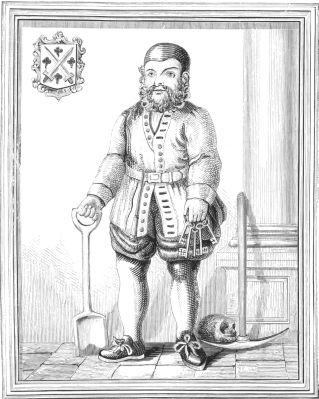
"The duties of sexton and parish clerk were usually performed by one person, as we have already frequently noticed, and therefore it is fitting that we should record the epitaph of Old Scarlett, most famous of grave-diggers, who buried two queens, both the victims of stern persecution, ill-usage, and Tudor tyranny--Catherine, the divorced wife of Henry VIII, and poor sinning Mary Queen of Scots. His famous picture in Peterborough Cathedral, on the wall of the western transept, usually attracts the chief attention of the tourist, and has preserved his name and fame. He is represented with a spade, pickaxe, keys, and a whip in his leathern girdle, and at his feet lies a skull. In [the upper left-hand corner appear the arms of the see of Peterborough, save that the cross-keys are converted into cross-swords. The whip at his girdle appears to show that Old Scarlett occupied the position of dog-whipper as well as sexton. There is a description of this portrait in the Book of Days, wherein the writer says:

"What a lively effigy--short, stout, hardy, self-complacent, perfectly satisfied, and perhaps even proud of his profession, and content to be exhibited with all its insignia about him! Two queens had passed through his hands into that bed which gives a lasting rest to queens and to peasants alike. An officer of death, who had so long defied his principal, could not but have made some impression on the minds of bishop, dean, prebends, and other magnates of the cathedral, and hence, as we may suppose, the erection of this lively portraiture of the old man, which is believed to have been only once renewed since it was first put up. Dr. Dibdin, who last copied it, tells us that 'old Scarlett's jacket and trunkhose are of a brownish red, his stockings blue, his shoes black, tied with blue ribbons, and the soles of his feet red. The cap upon his head is red, and so also is the ground of the coat armour.'" Beneath the portrait are these lines:
     YOU SEE OLD SCARLETTS PICTURE STAND ON HIE
     BUT AT YOUR FEETE THERE DOTH HIS BODY LYE
     HIS GRAVESTONE DOTH HIS AGE AND DEATH TIME SHOW
     HIS OFFICE BY THEIS TOKENS YOU MAY KNOW
     SECOND TO NONE FOR STRENGTH AND STURDYE LIMM
     A SCARBABE MIGHTY VOICE WITH VISAGE GRIM
     HEE HAD INTER'D TWO QUEENES WITHIN THIS PLACE
     AND THIS TOWNES HOUSEHOLDERS IN HIS LIVES SPACE
     TWICE OVER: BUT AT LENGTH HIS OWN TURNE CAME
     WHAT HE FOR OTHERS DID FOR HIM THE SAME
     WAS DONE: NO DOUBT HIS SOUL DOTH LIVE FOR AYE
     IN HEAVEN: THOUGH HERE HIS BODY CLAD IN CLAY.

Charles Turner B. abt 1841 - D. 1857

Edingthorpe, North Walsham
Charles Turner D 1857
All Saints, Edingthorpe

© Godric Godricson

George Hurn - D. 16th March 1919

Edingthorpe
George Hurn D. 16th March 1919
All Saints - Edingthorpe

© Godric Godricson

Saturday, 12 May 2012

La historia de entierros

 
Un viejo hombre visita una tumba
The Parish Clerk (1907)
Peter Hampson Ditchfield
Courtesy : Project Gutenburg
 
Mi nombre es Godric Godricson. Este blog está sobre la historia de entierros en al este de Inglaterra. Escribo sobre entierros en Inglaterra y en todo el mundo. Visito un cementerio y tomo las fotografías. También conduzco la investigación. Quisiera saber más sobre los cementerios de Suramérica. Quisiera exhibir las fotografías de cementerios antiguos en Suramérica.

Thursday, 10 May 2012

The Parish Clerk - 1907


The Parish Clerk (1907)
Peter Hampson Ditchfield
Courtesy : Project Gutenburg
The queries we have had to answer have been exceedingly numerous. Looking at the enclosure containing the console of the organ, a visitor wished to know whether the organist sat inside there. Another asked whether it was the vestry. One who saw great possibilities in such an organ inquired,  "Can he play this organ in any other place beside the key-board?" The pulpit being of so unique a character has had a full share of attention, and no lack of admirers. Gazing at it with eyes filled with wonderment, a woman said to her daughter, "Maria, you're not to touch not even the pews." Everything within sight of such a structure she held sacred. Astonished at its internal capacity, another asked, "Do all the clergy sit in it?" Not realising its true character and intent, a lady wished to know, "By whom was this monument erected?" As we had long since ascertained how impossible it was to please everybody, we were not surprised to find dissatisfied critics presenting themselves. One of this class said, "It looks like a tomb, and smells like a coffin." We append a few more questions we have had to answer:


"Was this church built by St. Nicholas?"
"Does this church stand in four parishes?"
"How many miles is it round the walls of this church?"
"How many does this hold? We were told it holds 12,000."
A clergyman asked, "Where are the bells? Are they in the tower?"
"Haven't you a Bible 3000 years old?"
"Haven't you a Bible that turns over its own leaves?"
"Who had the missing leaves of this (Cranmer's) Bible?"
"Is this the Bible that was chained in Brentwood Church?"
A lady pointing to the font asked, "Is that the Communion Table?"
An elderly lady at the brass lectern inquired, "Is this the clerk's seat?"
A man standing looking over the Communion rails wished to know, "What part of the church do you call this?"
"Was one of the giants buried in the churchyard?"
"Where is the gravestone where a man, his wife, and twenty-five children were buried? I saw it when I was here some years ago, and forget on which side of the church it is."
A young man gazing at the top of the lofty flagstaff just inside the churchyard gates, asked, "Was that erected to the memory of a shipwrecked crew?"

With such extraordinary exhibitions of blatant ignorance can a worthy clerk regale himself, but they must be very trying at times.

Trinitarian thoughts

The Cemetery is a place of reintegration and of community and has been so from a period before the introduction of Christianity in Britain. The dead are reincorporated with their compatriots and the sextons of the past ensured that the dead were stacked and layered to wait for their Resurrection.

The Trinity is a complex doctrine of the Christian faith that also implies at a Divine level a continuing integration beyond the understanding of humanity. The Trinity requires study and reflection to be fully understood and we need to bear in mind the idea of intermingling and integration to understand the doctrine. Denominations often have distinctive views of ‘The Trinity’ and often those denominational views are mutually exclusive and the object of intense debate. We often hate the things and ideas that are closest to us and accept ideas that are stranger and from further away. We can see a continuing development of the doctrine of The Trinity over time from a fairly limited statement of belief by the 4th Century Church at Nicea to a much more developed series of beliefs in the 21st century. The Trinity has become a sort of magic that is a test of orthodoxy and a trap for the unwary who speak without reference to the highly technical and specific language often used in the debate.

© Godric Godricson
Many people initially hear about ‘The Trinity’ from Church services in the Nicene Creed which exposes people to the doctrine and emphasises the central importance of the doctrine.

“I believe in the Holy Ghost, the Lord and Giver of life, who proceeds from the Father and the Son, who together with the Father and the Son is to be adored and glorified, who spoke by the Prophets”. (Wilhelm, Joseph. "The Nicene Creed." The Catholic Encyclopedia. Vol. 11. New York: Robert Appleton Company, 1911. 15 Nov. 2009

The Nicene Creed sets out the very basic and unelaborated tenets of the doctrine without explaining that doctrine in detail and this ‘vagueness’ allows debate, confusion and conflict.

In response; The Roman Catholic Church tried to explain and codify the doctrine as part of the “Catechism of the Catholic Church”. Emphasising that the doctrine is a core  ‘mystery’; the Catechism teaches the doctrine in a ‘pithy’ style that draws upon the historical teaching of this particular denomination. Such a mystery relies upon God to reveal the mystery to others and cannot, in isolation, be understood by humanity with reference to reason alone. Equally, the Trinity cannot be understood without reference to the Incarnation. The catechism is a succinct  statement of doctrine that tries to free the denomination from perceived doctrinal error. The Catechism also introduces  specific Church terminology such as "consubstantial Trinity"  which are explained; although,  the explanation is sometimes so highly refined that it is inaccessible for the majority of congregations. Regrettably, humanity tries to understand The Trinity and the interwoven idea of God without thinking about how humanity itself is interwoven in death and for all eternity. Humanity is interwoven in death and in dissolution and although the imagery is sometimes macabre we need to hold onto that idea.

© Godric Godricson

Building on earlier explorations of the doctrine (and acknowledging that some Protestant denominations totally refute the doctrine); Karl Rahner (SJ) has written extensively in this area such as “The Trinity” (1967). Rahner  developed earlier intellectual statements of belief towards a  further refined perception and enhanced an understanding of this doctrine by exploring themes such as the “economic Trinity”  and the “Immanent  Trinity”. Such developments are intellectually complicated and sometimes esoteric although, ultimately, Rahner encourages thinking about the doctrine and it may be that this introspection and reflection may bear fruit as we consider the cemetery.

I would suggest that there are parallels in our consideration of The Trinity and our consideration of death and disintegration as such matters bring humanity together in the ground and in the ashes that we leave behind. Even if we have not lived together, we have the opportunity to coexist together for eternity.

William Brereton Landymore (1815-1892)

William Brereton Landymore

© Godric Godricson

Richard Call - Buried February 13th 1715


Richard Call Died 1715
All Saints Edingthorpe

© Godric Godricson


Wednesday, 9 May 2012

Dealings with the Dead - 1856

In 1810, the disgusting confusion, in the catacombs of Paris, was so much a subject of indignant remark, that orders were issued to put things in better condition. A plan was adopted, for piling up the bones. In some places, these bones were thirty yards in thickness; and it became necessary to cut galleries through the masses, to effect the object proposed.
There were two entrances to the catacombs—one near the barrier d’Enfer, for visitors—the other, near the old road to Orleans, for the workmen. The staircase consisted of ninety steps, which, after several windings, conducted to the western gallery, from which others branched off, in different directions. A long gallery, extending beneath the aqueduct of Arcueil, leads to the gallery of Port Mahon, as it is called. About a hundred yards from this gallery, the visitor comes again to the passage to the catacombs; and, after walking one hundred yards further, he arrives at the vestibule, which is of an octagonal form. This vestibule opens into a long gallery, lined with bones, from top to bottom. The arm, leg, and thigh bones are in front, compactly and regularly piled together. The monotony of all this is tastefully relieved, by three rows of skulls, at equal distances, and the smaller bones are stowed behind. How very French! This gallery leads to other apartments, lined with bones, variously and fancifully arranged. In these rooms are imitation vases and altars, constructed of bones, and surmounted with skulls, fantastically arranged. This really seems to be the work of some hybrid animal—a cross, perhaps, between the Frenchman and the monkey.
William Harmer
Burial in Church at Saint Botolph's - Trunch
© Godric Godricson
These crypts, as they are called, are designated by names, strangely dissimilar. There is the Crypte de Job, and the Crypte d’Anacreon—the Crypte de La Fontaine, and the Crypte d’Ezekiel—the Crypte d’Hervey, and the Crypte de Rousseau. An album, kept here, is filled with mawkish sentimentality, impertinent witticism, religious fervor, and infidel bravado.
The calculations vary, as to the number of bodies, whose bones are collected here. At the lowest estimate, the catacombs are admitted to contain the remains of three millions of human beings.
While contemplating the fantastical disposition of these human relics, one recalls the words of Sir Thomas Browne, in his Hydriotaphia—“Antiquity held too light thoughts from objects of mortality, while some drew provocatives of mirth from anatomies, and jugglers showed tricks with skeletons.”
Here then, like “broken tea-cups, wisely kept for show,” are the broken skeletons of more than three millions of human beings, paraded for public exhibition! Most of them, doubtless, received Christian burial, and were followed to their graves, and interred, with more or less of the forms and ceremonies of the Catholic church, and deposited in the earth, there to repose in peace, till the resurrection! How applicable here the language of the learned man, whom we just quoted—“When the funeral pyre was out, and the last valediction over, men took a lasting adieu of their interred friends, little expecting the curiosity of future ages should comment upon their ashes; and having no old experience of the duration of their relics, held no opinion of such after-considerations. But who knows the fate of his bones, or how often he is to be buried! Who hath the oracle of his ashes, or whither they are to be scattered?” How little did the gay and guilty Jeane Antoinette Poisson, Marquise de Pompadour, imagine this rude handling of her mortal remains! She was buried in the Cemetery des Innocens, in 1764—and shared the common exhumation and removal in 1805.
The Aristocracy of the dead
© Godric Godricson
It seems to have been the desire of mankind, in every age and nation, to repose in peace, after death. In conformity with this desire, the cemeteries of civilized nations, the morais of the Polynesian isles, and the cities of the dead, throughout the world, have been, from time immemorial, consecrated and tabooed. So deep and profound has been the sentiment of respect, for the feelings of individuals, upon this subject, that great public improvements have been abandoned, rather than give offence to a single citizen.
Near forty years ago, a meeting was held in Faneuil Hall, to consider a proposition for some change, in the Granary burying-ground, which proposition, was rejected, by acclamation. During the Mayoralty, of the elder Mr. Quincy, it was the wish of very many to continue the mall, through the burial-ground, in the Common. The consent of all, but two or three, was obtained. They were offered new tombs, and the removal of their deceased relatives, under their own supervision, at the charge of the city. These two or three still objected, and this great public improvement was abandoned; and with manifest propriety. The basis of this sentiment is a deep laid and tender respect for the ashes of the dead, and an earnest desire, that they may rest, undisturbed, till the resurrection; and this is the very last thing, which is likely to befall the tenant of a TOMB; for the owner—and tombs, like other tenements, will change owners—in the common phraseology of leases, has a right to enter, “to view, and expel the lessee”—if no survivor is at hand to prevent, and the new proprietor has other tenants, whom he prefers for the dark and gloomy mansion. And they, in process of time, shall be served, in a similar manner, by another generation. This is no exception; it is the general rule, the common course of dealing with the dead. A tomb, containing the remains of several generations, may become, by marriage, the property of a stranger. His wife dies. He marries anew. New connections beget new interests. The tomb is useless, to him, because it is full. A general clearance is decreed. A hole is dug in the bottom of the tomb; the coffins, with an honorable exception, in respect to his late beloved, are broken to pieces; and the remains cast into the pit, and covered up. The tablet, overhead, perpetuates the lie—“Sacred to the memory,” &c. However, the tomb is white-washed, and swept out, and a nice place he has made of it! All this, have I seen, again and again.
 The dead progress into
the world of the living
© Godric Godricson
When a tomb is opened, for a new interment, dilapidated coffins are often found lying about, and bones, mud, and water, on the bottom. We always make the best of it, and stow matters away, as decently as we can. We are often blamed for time’s slovenly work. Grossman said, that a young spendthrift, who really cared for nothing but his pleasures, was, upon such an occasion, seized with a sudden fit of reverence for his great grandfather, and threatened to shoot Grossman, unless he produced him, immediately. He was finally pacified by a plain statement, and an exhibition of the old gentleman’s bones behind the other coffins. We could not be looked upon, more suspiciously, by certain inconsiderate persons, if we were the very worms that did the mischief. As a class, we are as honorable as any other. There are bad men, in every calling. There is no crime, in the decalogue, or out of it, which has not been committed, by some apostle, in holy orders. Doctors and even apothecaries are, occasionally, scoundrels. And, in a very old book, now entirely out of print, I have read, that there was, in the olden time, a lawyer, rara avis, who was suspected of not adhering, upon all occasions, to the precise truth. Tombs are nuisances. I will tell you why.

Project Gutenburg : Dealings with the Dead, Volume I (of 2)
Author: A Sexton of the Old School Boston 1856

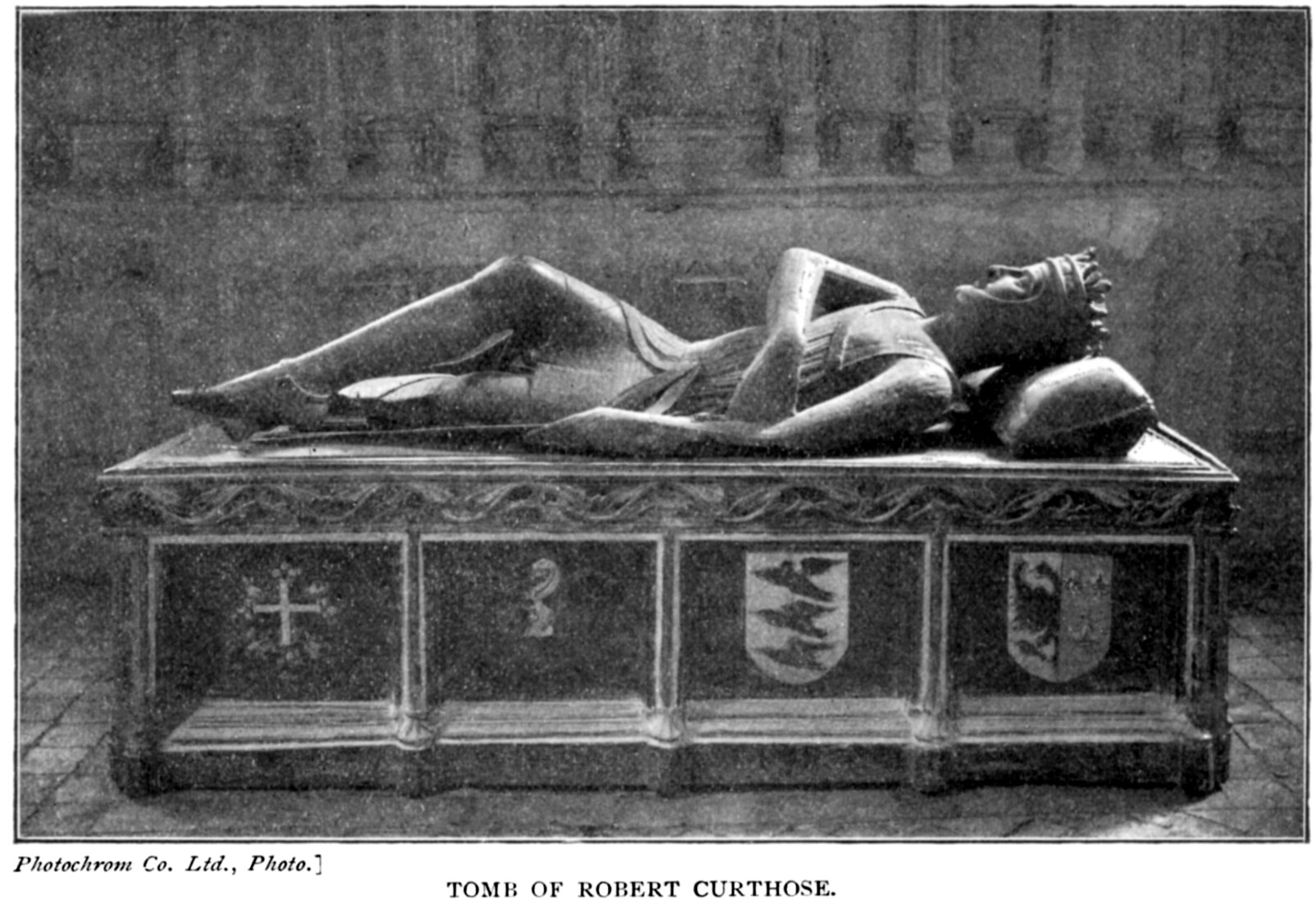
Tomb of Robert Curthose - Gloucester Cathedral


Mary Leach Died 24th February 1760

All Saints Parish Church, Edingthorpe

© Godric Godricson

Walter Henry Renacre - Swafield

Walter Henry Renacre - Swafield
© Godric Godricson

Commander Jeaffreson Miles - Knapton


Commander Jeaffreson Miles
© Godric Godricson


Tuesday, 8 May 2012

Bishop John de Sheppey of Rochester


image

(from a photograph by J. L. Allen Courtesy: Project Gutenburg ).

"The effigy itself has been much praised, and deservedly. The sculpture, in stone, is excellent, and the colours have a fine effect. It is surprising to see how general is the belief that this is “probably the most perfect specimen of ancient colouring now existing in England,” and how even great authorities refer to “its very perfect original colouring;” for in the “Gentleman’s Magazine” (September, 1825) we can read how the monument was treated just after its discovery. A Mr. Harris, in Mr. Cottingham’s employ, made two drawings of the effigy, one showing it as it was, the other as the architect thought it had been. The restoration of the colours, according to the second drawing, was then resolved on and carried out, and, as a result, “the dalmatic, instead of being a pink, is now a dull scarlet, with a green lining, and the shoes are painted yellow.” Matters are still worse when we see Mr. Harris complaining (in a letter now at the British Museum) that the renovation according to his drawing was done “by an unskilful hand, consequently the remains of the beautiful colouring were destroyed, which was much regretted by the dean, Dr. Stevens, at the time.” The sculpture seems fortunately not to have been tampered with; some fragments luckily discovered were fitted in their places, but no further restoration was attempted. These fragments were the top of the mitre, most of the fingers, the feet, and the head of one of the little dogs lying thereby.

The bishop’s face, naturally coloured like the rest of the effigy, is rather mutilated, but seems to have been close shaven. Under his outermost robe, the chasuble, comes the dalmatic, through the side openings of which the rich green of the tunic appears. The colour of the latter robe used, however, to be scarcely visible. The ends of the stole do not appear, but, under all, the alb hangs down to the feet. The apparel of the alb, the amice round his neck, and the maniple of his left arm are shown as richly embroidered with gold. The bishop wears jewelled gloves, and on the fourth finger of his left hand the episcopal ring, of gold set with a ruby. His head, with the precious mitre, rests on two cushions, and finally against his left shoulder lies the splendid crosier, of which, unfortunately, the crook is gone.

On the side towards the choir, of the slab on which he rests, we read “hic iacet dns iohans de schepeie epus huius ecclie.” The same words appear on the other side, except that istius takes the place of huius, a change which implies some independence in the chapel.

The railing before the tomb perhaps belonged to it originally. Along the upper band should be noticed the curious pounced pattern, and its three massive lily spikes cannot but attract attention. It was the occurrence of the letters i s, the bishop’s initials, just under the central spike, that led to the railing being brought hither from another part of the church".

Bishop of Manchester James Fraser (1818-1885)

"The Fraser Chapel contains an altar cenotaph in memory of the second Bishop of Manchester, who died October 22nd, 1885, at Bishop's Court, Higher Broughton, Manchester, but who was buried, not in his cathedral church, but in the churchyard of Ufton Nervet in Berkshire, a parish of which he had once been rector. The recumbent statue is considered to be a fine likeness of the late bishop. This statue was unveiled on July 8th, 1887. The tomb bears the following inscription written by the late Dr Vaughan, Dean of Llandaff."

"To the beloved memory of James Fraser, D.D., Bishop of Manchester, 1870-85, a man of singular gifts both of nature and the spirit; brave, true, devout, diligent, in labours unwearied. He won all hearts by opening to them his own, and so administered this great Diocese as to prove yet once more that the people know the voice of a good shepherd and will follow where he leads."

John Leach Died 20th March 1753

All Saints Parish Church, Edingthorpe

© Godric Godricson


Surname: Leach
Given Name: Joland
Sex: M
3 Aug 1718 in Tombland, Norwich, Norfolk, England
Christening: 3 Aug 1718 Tombland, Norwich, Norfolk, England
Died: 25 Feb 1754 All Saints, Edingthorpe