Friday, 8 June 2012

The State of the Blessed Dead


By
HENRY ALFORD, D. D.,
DEAN OF CANTERBURY.

Graphic
LONDON:
HODDER AND STOUGHTON,
27, PATERNOSTER ROW.
I have already announced that during this Advent season I would cal your attention to the state of the blessed dead. My object in so doing is simply that we may recall to ourselves that which Scripture has revealed respecting them, for our edification, and for our personal comfort. And I would guard that which will be said by one or two preliminary observations.

With Death as an object of terror, with Death from the mere moralist’s point of view, as the termination of human schemes and hopes, we Christians have nothing to do. We are believers in and servants of One who has in these senses abolished Death. Our schemes and hopes are not terminated by Death, but reach onward into a state beyond it.

Again, with that state beyond, except as one of blessedness purchased for us by the Son of God, I am not at present dealing. It is of those that die in the Lord alone that I speak.

And this being so, it is clear that the first point about them demanding our attention is, the very commencement of their state at the moment of death. And this will form our subject to-day.


"To-day shalt thou be with Me in paradise"
© Godric Godricson
  
We shall be guided in its consideration by two texts of Holy Scripture. The one is that where Our Lord answers the prayer of the dying thief that He would remember him when He came into His kingdom, Luke xxiii. 43: “Verily I say unto thee, To-day shalt thou be with Me in paradise.”

And the other is an expression of St. Paul, Phil. i. 23, not improbably taken from those very words recorded in the gospel of that evangelist who was his companion in travel—“to depart and to be with Christ.”

Now in both these one fact is simply declared, viz.: that the departed spirit of the faithful man is with Christ. It is as if one bright light were lifted for us in the midst of a realm brooded over by impenetrable mist. For who knows whither the departed spirit has betaken itself when it has left us here? One of the most painful pangs in bereavement by death is the utter and absolute severance, without a spark of intelligence of the departed. One hour, life is blest by their presence; the next, it is entirely and for ever gone from us, never to be heard of more. One word, one utterance—how precious in that moment of anguish do we feel that it would be! But we are certain it never will be granted us. None has ever come back who has told the story. Where the spirit wakes and finds itself,—this none has ever declared to us; nor shall we know until our own turn comes. Now in such a state of uncertainty, these texts speak for us a certain truth: The departed spirit is with Christ.

I shall regard this revelation negatively and positively: as to what it disproves, and as to what it implies.


First, then, it disproves the idea of the spirit passing at death into a state of unconsciousness, from which it is to wake only at the great day of the resurrection. If it is to be with Christ, this cannot be. Christ is in no such state of unconsciousness; He has entered into His rest, and is waiting till all things shall be put under His feet; and it would be a mere delusion to say of the blessed dead, that they shall be with Christ, if they were to be virtually annihilated during this time that Christ is waiting for His kingdom. Besides, how then would the Lord’s promise to the thief be fulfilled? What consolation would it have been to him, what answer to his prayer, to be remembered when Jesus came in His kingdom, if these words implied that he should be unconsciously sleeping while the Lord was enjoying his triumph? Therefore we may safely say, that the so-called “sleep of the soul,” from the act of death till the resurrection, has no foundation in that which is revealed to us.


In the presence of Christ
© Godric Godricson
 
We have now to consider what this implies. And in doing so we shall have further to make certain that which we think we have already proved. For first, it clearly implies more than a mere expression of safe-keeping, or reserve for a future state of blessedness. “The righteous souls are in the hand of God, and there shall no harm happen to them.” This is one thing: but to be with Christ is another. We might again appeal to the spirit of the promise made to the penitent thief, in order to show this: we might remind you that in the other text, St. Paul is comparing the two states—life in the midst of his children in the faith, and death; and he says, “I have a desire to depart and to be with Christ, which is far better:” better than being with you, my Philippians.

So that more must be meant than mere safe keeping in the Redeemer’s hands. We may surely say, that nothing less than conscious existence in the presence of Christ can be intended. And if that is intended, then very much more is intended also, than those words at first seem to imply. Remember the contrast which this same Apostle elsewhere draws. “We know,” he says, “that while we are present in the body, we are absent from the Lord: for we walk by faith, not by appearance: we are willing rather to be absent from the body and present with the Lord.” That is, if we follow out the thought, this present state of dwelling in our home the body is a state of severance from the Lord; but there is a better state, into which we shall be introduced when this house of the body is pulled down: and from the context in that place we may add, much as we wish to be clothed upon with our new and glorious body which is from heaven, yet even short of that, we have learned to prefer being simply unclothed from the body, because thus we shall be present with the Lord.


“Beloved, now are we children of God"
© Godric Godricson
 
So that we may safely assume thus much, my brethren: that the moment a Christian’s spirit is released from the body, it does enter into the presence of our Blessed Lord and Saviour, in a way of which it knows nothing here: a way which, compared to all that its previous faith could know of Him, is like presence of friends compared to absence.

Now let us take another remarkable passage of Holy Writ bearing on this same matter. St. John, in his first Epistle says, “Beloved, now are we children of God, and it never yet was manifested what we shall be; but if it should be manifested, we know that we shall be like Him: for we shall see Him as He is:” for this is the more accurate rendering of the words: meaning, if any one could come back, or come down, to us, and tell us what our future state is to be, the information could amount for us now only to this, that we shall be like Him, like Christ; because we shall see Him as He is. And in treating these words at considerable length last year, I pressed it on you that this concluding sentence might bear two meanings: either, we shall be like Him, because in order to see Him as He is, we must be like Him; or, we shall be like Him, because the sight of Him as He is will change us into His perfect likeness. For, our present purpose, or indeed for any purpose, it matters little which of these meanings we take. At any rate, we have gained this knowledge from St. John’s words, that the sight of the Blessed Lord which will be enjoyed by the Christian’s spirit on its release from the body, will be accompanied by being also perfectly like Him.

Now, here, my brethren, are the elements of an immediate change, blessed and joyous beyond our conception. Let us spend the rest of our time to-day in dwelling upon it.

And I will not now insist on the deliverance of the spirit from the infirmity, or pain, or decay of the body; because this is not so in all cases. Many a Christian’s spirit is set free from a body in perfect vigour and health. Let us take nothing but what is common to all who believe in and serve the Lord. Now what is our present state with reference to Him whom all Christians love? It is, absence. And it is absence aggravated in a way that earthly absence never is. For not only have we never seen Him, which is a case perfectly imaginable in earthly relations, but also, which hardly is, we have no absolute proof of His existence, nor of His mind towards us. Even as far as this, is matter of faith and not of appearance. We have no token, no communication, from Him. I suppose there hardly ever was a Christian yet, living under the present dispensation, entirely dependent upon his faith, who has not at some time or other had the dreadful thought cross his mind—overborne by his faith, but still not wholly extinguished, “What if it should not be true after all?” And much and successfully as we may contend with these misgivings of unbelief, yet that frame of mind which is represented by them, that wavering, fitful, unsteady faith, ever accompanies us. The distress arising from it is known to every one who has the Christian life in him. Only those never doubt who have never believed: for doubt is of the very essence of belief. But some poor souls are utterly cast down by the fact of its existence—shrink from these half-doubting fits as of themselves deadly sin, and are in continual terror about their soul’s safety on this account: others, of stronger minds, regard them truly as inevitable accompaniments of present human weakness, but of course struggle with them, and evermore yearn to be rid of them.

Now if what we have been saying be true,—and I have endeavoured not to go beyond the soberest inferences from the plain language of Scripture,—if so much be true, then the moment of departure from the body puts an end for ever to this imperfect, struggling, fitful state of faith and doubt. The spirit that is but a moment gone, that has left that well-known, familiar tabernacle of the body a sudden wreck of inanimate matter, that spirit is with the Lord. All doubt, all misgiving, is at an end. Every wave raised by this world’s storms, this world’s currents of interest, this world’s rocks and shallows, is suddenly laid, and there is a great calm. Certainty, for doubt—the sight of the Lord, for the conflict of assurance and misgiving—the face of Christ, for the mere faith in Christ—these have succeeded, because the departed spirit is “with the Lord”—companying with Him.

© Godric Godricson

Before we follow this out farther, let us carefully draw one great distinction. We must not make the too common mistake of confusing this sight of the Lord which immediately follows on the act of death, with that complete state of the glorified Christian man, of which we shall have to speak in a subsequent sermon. Though greater than our thoughts can now conceive, the bliss of which we are speaking to-day is incomplete. The spirit which has been set free from the body is alone, and without a body. This is not the complete state of man. It is a state to us full of mystery—inconceivable in detail, though easily apprehended as a whole. We must take care, in what we have further to say, that this is fully borne in mind. And, bearing it in mind, let us proceed.

This sight of Christ, this calm of full unbroken assurance of His nearness and presence, what does it further imply? As far as we can at present see, certainly as much as this. First, the entire absence of evil from the spirit. It would be impossible to be with Christ in any such sense, unless there were entire agreement in will and desire with Him. It would be impossible thus to see Him as He is, without being like Him.

Let us imagine, if we can, the effect of the total extinction of evil in any one of our minds. How many energies, now tied and bound with the chain of sin, would spring upward into action! How many imprisoned yearnings would burst their bonds, and carry us onward to higher degrees of good! And all these energies, all these yearnings, can exist in the disembodied spirit. It is in a waiting, a hoping state: the greater the upward yearnings, the greater the accumulated energies for God and His work, the higher will be the measure of glory to be attained after the redemption of the body, and the completion of the entire man.

Well—as another consequence, following close on the last, all conflict, from that same moment, is at an end. Conflict is ordained for us, is good for us, now. If it were to cease here below, we should fall back. We have not entered into rest, it would not be good for us to enter into rest, in our present state. Here, this little platform, so to speak, of our personality, is drawn two ways, downward and upward: and it is for us who stand thereon, to keep watch and ward that the downward prevail not; but from that moment, the dark links of the downward chain will have been for ever severed, and the golden cord that is let down from the Throne will bear us upward and onward, unopposed. So that as to conflict, there will be perfect rest.
© Godric Godricson
And let us remember another matter. If the departed spirit were during this time dwelling on its own unworthiness, casting back looks of self-reproach, weighing accurately God’s mercies and its own requitals during life past, there would of necessity be conflict: there would be bitter self-loathing, there would be pangs of repentance. It would seem, then, that during the incomplete and disembodied state, this is not so; but that all of this kind is reserved for a day when account is to be given in the body of things done in the body: and we shall see, when we come to treat of that day specially, how its account will be, for the blessed dead, itself made a blessing.

Again, as all evil will be at an end, and all conflict,—so will all labour, “Blessed are the dead which die in the Lord: even so saith the Spirit, for they rest from their labours.” Now labour here is a blessing, it is true: but it is also a weariness. It leads ever on to a greater blessing, the blessing of rest. Christ has entered into His rest; and the departed spirit shall be with Christ: faring as He fares, and a partaker of His condition. Any who have lived the ordinary term of human life in God’s service (for it is only of such that we are now speaking) can testify how sweet it is to anticipate a cessation of the toil and the harassing of life: to be looking on to keep the great Sabbath of the rest reserved for the people of God. What more may be reserved for us in the glorious perfect state which shall follow the resurrection, is another consideration altogether: but it clearly appears that the intermediate disembodied state is one of rest.

And let none cavil at the thought, that thus Adam may have rested his thousands of years, and the last taken of Adam’s children only a few moments. Time is only a relative term, even to us. A dream of years long may pass during the sound that awakens a man; and a sleep of hours appears but a second. What do we know of time, except as calculated by earthly objects? Day and night, the recurrence of meals,—these constitute time to us: shut up a man in darkness, and administer his food at irregular intervals, and he loses all count of time whatever. Surely, then, no cavil on this score can be admitted. In that presence where the departed spirits are, one day is as a thousand years, and a thousand years as one day.

© Godric Godricson
Let us conclude with a consideration, to a Christian the most glorious of all. The spirit that is with Christ in nearest presence and consciousness, knows Him as none know Him here. Here, we speak of His purity, His righteousness, His love, His triumph and glory, with miserably imperfect thoughts, and in words still more imperfect than our thoughts. We are obliged to employ earthly images to set forth heavenly things. The revelations of Scripture itself are made through a medium of man’s invention, and are bounded by our limited vocabulary. But then it will be so no longer. The Apostle compares our seeing here to that of one who beholds the face of his friend in a mirror of metal, sure to be tarnished and distorting: and our vision there to beholding the same face to face,—the living features, the lips that move, the eyes that glisten. That spirit which has but now passed away, knows the love that passes our knowledge; contemplates things which God has prepared for them that love Him, such as eye has never seen, nor ear heard, nor hath it entered into the heart of man to conceive.

Therefore, beloved, let us be of good cheer concerning them that have fallen asleep through Jesus: and let us be of good cheer respecting ourselves. Good as it is to obey and serve God here, it has been far better for them to depart and to be with Christ; and it will be far better for us, if we hold fast our faith and our confidence in Him firm unto the end. If to us to live is Christ, then to us to die will be gain.

Besuch der Kaisergruft (Kapuzinergruft) in Wien


This video is just for fun. I love the Imperial Vault in Vienna.

Robert Goodson - Rackheath


© Godric Godricson

English cemeteries are surprising places and Rackheath is no exception. I had imagined that a cemetery cross is pretty standard although in Rackheath we find a cross looking very different to others and here Robert Goodson's grave is marvellous. The cross is ornate and imaginative. On the day that I visited, it was sunny and hot at around 27 centigrade although in the current cold June it is hard to imagine that temperature anymore.

John Lee - Edingthorpe

© Godric Godricson

Monument park


© Godric Godricson
I love pictures like this as photography gathers together different periods of monuments and memorials in one collection. The stonework memorials look like a sculpture park of inscriptions, hope and aspiration. The work involved in this collection is enormous if we add together the stone masons, the labour involved in putting the monuments together and the grass cutters over the years who have kept the monuments clear of greenery. Despite this the monuments start to fall apart and disintegrate. Graveyards are clearly high maintenance to keep clear and an even higher cost to individuals to create in the first place.

Swafield


© Godric Godricson


This is a reflective picture of Swafield earlier in the year and before the weather changed for the worse. From the perspective of a very wet and cold June the earlier part of the year seems preferable.

Thursday, 7 June 2012

Dealings with the Dead - 1856

Project Gutenburg :

Dealings with the Dead, Volume I (of 2)
A Sexton of the Old School 
Boston 1856
Tombs are obviously more liable to invasion, with and without assistance, from the undertaker and his subalterns, than graves. There may be a few exceptions, where the sexton does not cooperate. If a grave be dug, in a suitable soil, of a proper depth, which is some feet lower than the usual measure, the body will, in all probability, remain undisturbed, for ages, and until corruption and the worm shall have done their work, upon flesh and blood, and decomposition is complete. An intelligent sexton, who keeps an accurate chart of his diggings, will eschew that spot. On the other hand, every coffin is exposed to view, when a tomb is opened for a new comer. On such occasions, we have, sometimes, full employment, in driving away idlers, who gather to the spot, to gratify a sickly curiosity, or to steal whatever may be available, however “sacred to the memory,” &c. The tomb is left open, for many hours, and, not infrequently, over night, the mouth perhaps slightly closed, but not secured against intruders. During such intervals, the dead are far less protected from insult, and the espionage of idle curiosity, than the contents of an ordinary toy-shop, by day or night. Fifty years ago, curiosity led me to walk down into a vault, thus left exposed. No person was near. I lifted the lid of a coffin—the bones had nearly all crumbled to pieces—the skull remained entire—I took it out, and, covering it with my handkerchief, carried it home. I have, at this moment, a clear recollection of the horror, produced in the mind of our old family nurse, by the exhibition of the skull, and my account of the manner, in which I obtained it. “What an awful thing it would be,” the dear, good soul exclaimed, “if the resurrection should come this very night, and the poor man should find his skull gone!” My mother was informed; and I was ordered to take it back immediately: it was then dark; and when I arrived at the tomb, in company with our old negro, Hannibal, to whom the office was in no wise agreeable, the vault was closed. I deposited the skull on the tomb, and walked home in double quick time, with my head over my shoulder, the whole way. I relate this occurrence, to show how motiveless such trespasses may be.

Rev. Edward William Dowell - Dunton
© Godric Godricson
There is a morbid desire, especially in women, which is rather difficult of analysis, to descend into the damp and dreary tomb—to lift the coffin lid—and look upon the changing, softening, corrupting features of a parent or child—to gaze upon the mouldering bones; and thus to gather materials, for fearful thoughts, and painful conversations, and frightful dreams!

A lady lost her child. It died of a disease, not perfectly intelligible to the doctor, who desired a post mortem examination, which the mother declined. He urged. She peremptorily refused. The child was buried in the Granary ground. A few months after, another member of the same family was buried in the same vault. The mother, notwithstanding the remonstrances of her husband, descended, to look upon the remains of her only daughter; and, after a careful search, returned, in the condition of Rachel, who would not be comforted, because it was not. In a twofold sense, it was not. The coffin and its contents had been removed. The inference was irresistible. The distress was very great, and fresh, upon the slightest allusion, to the end of life. Cases of premature sepulture are, doubtless, extremely rare. That such, however, have sometimes occurred, no doubt has been left upon the mind, upon the opening of tombs. These are a few only of many matters, which are destined, from time to time, to be brought to light, upon the opening of tombs, and which are not likely to disturb the feelings of those whose deceased relatives and friends are committed to well-made graves. On all these occasions, ignorance is bliss.


William Case - Dunton
© Godric Godricson

Tombs, not only such as are constructed under churches, but in common cemeteries, are frequently highly offensive, on the score of emanation. They are liable to be opened, for the admission of the dead, at all times; and, of course, when the worms are riotous, and corruption is rankest, and the pungent gases are eminently dangerous, and disgusting. Even when closed, the intelligible odour, arising from the dissolving processes, which are going on within, is more than living flesh and blood can well endure. Again and again, visitors at Mount Auburn have been annoyed, by this effluvium from the tombs. By the universal adoption of well-made graves, this also may be entirely avoided.

Phillip Mallett Case  (1771-1834)
Saint Peter's Church - Dunton
Tombs beneath the plaque
© Godric Godricson
When a family becomes, or is supposed to be, extinct, or has quitted the country, their dead kindred are usually permitted to lie in peace, in their graves. It is not always thus, if they have had the misfortune to be buried in tombs. To cast forth a dead tenant, from a solitary grave, that room might be found for a new  comer, would scarcely be thought of; but the temptation to seize five or six tombs, at once, for town’s account, on the pretext, that they were the tombs of extinct families, has, once, at least, proved irresistible, and led to an outrage, so gross and revolting, in this Commonwealth, that the whole history of cemeteries in our country cannot produce a parallel. In April, 1835, the board of health, in a town of this Commonwealth, gave notice, in a single paper, that certain tombs were dilapidated; that no representative of former owners could be found; and that, if not claimed and repaired, within sixty days, those tombs would be sold, to pay expenses, &c. In fulfilment of this notice, in September following, the entire contents of five tombs were broken to pieces, and shovelled out. In one of these tombs there were thirty coffins, the greater part of which were so sound, as to be split with an axe. A portion of the silver plate, stolen by the operatives employed by the board of health, was afterwards recovered, bearing date, as recently as 1819. The board of health then advertised these tombs for sale, in two newspapers. Nothing of these brutal proceedings was known to the relatives, until the deed of barbarity was done. Now it can scarcely be credited, that, in that very town, a few miles from it, and in this city, there were then living numerous descendants, and relatives of those, whose tombs had thus been violated. Some of the dead, thus insulted, had been the greatest benefactors of that town, so much so, that a narrative of their donations has been published, in pamphlet form. Among the direct descendants were some of the oldest and most distinguished families of this city, whose feelings were severely tried by this outrage. The ashes of the dead are common property. The whole community bestirs itself in their defence. The public indignation brought those stupid and ignorant officials to confession and atonement, if not to repentance. They passed votes of regret; replaced the ashes in proper receptacles within the tombs; and put them in order, at the public charge.

Burials in tombs under the altar

© Godric Godricson
A meagre and miserable atonement, for an injury of this peculiar nature; and, though gracelessly accorded,—extorted by the stringency of public sentiment, and the fear of legal process,—yet, on the whole, the only satisfaction, for a wrong of this revolting and peculiar character. The insecurity of tombs is sufficiently apparent. An empty tomb may be attached by creditors; but, by statute of Mass., 1822, chap. 93, sec. 8, it cannot be, while in use, as a cemetery. But no law, of man or nature, can prevent the disgusting effects, and mortifying casualties, and misconstructions of power, which have arisen, and will forever continue to arise, from the miserable practice of burying the dead, in tombs.

Victorian Cross

© Godric Godricson

William Henry Tolman

© Godric Godricson

Celtic cross - Tomnahurich

©Michelle of Crowsfeet blog

Victorian Gardens of rest


A broad pathway at Tomnahurich

©Michelle of Crowsfeet blog

The Victorians planned many wonderful garden cemeteries that cleared away the horrors of the cemetery as described by Edwin Chadwick and the Sexton in "Dealings with the Dead".  Tomnahurich near Inverness is a wonderful Scottish example of this sort of Garden Cemetery. My thanks for the photographs.

Tomnahurich


Tomnahurich Cemetery
Near Inverness

©Michelle of Crowsfeet blog
  

Wednesday, 6 June 2012

Mystery of a vault

Hawera & Normanby Star
"A tale of the mysterious movement of coffins in a sealed vault in the parish of Christchurch, Barbados, has long been told in the island. Fresh authentic evidence (1908) just brought to light and published this week in the West India Committee's Circular, confirms the story, and renders it mysterious in the extreme. On successive occasions when the  Chase family vault in the churchyard near Ostins Town was opened the coffins were found to be disarranged. A manuscript account by the Hon. Nathan Lucas, who witnessed the opening of the vault in 1820, has been unearthed. The document states that the vault was opened several times for the interment of bodies in the first decade of the nineteenth century. Each time the coffins were found in extraordinary positions, and after a burial in 1819.  Mr Lucas was discussing it with friends in 1820, and they decided there and then to see if the coffins had moved again. They found the heavy slabs over the entrance' untouched, and no marks of violence were anywhere visible. But in the vault itself the six coffins were once again disarranged, lying on top of each other and at certain angles. The vault was in such a position that waterr or which there were no signs could not have flooded it. There had been no earthquake to account for the mystery and no attempt to rob the corpses".


Mary and Robert Knopwood - Threxton


All Saints - Threxton

© Godric Godricson


War Dead - Herbert James Hoggett


Saint Andrew - Little Cressingham

© Godric Godricson
 

Vault desecrated in Lancashire


“SICK” teenage vandals have been slammed for desecrating an historic family vault in Blackburn Cemetery. [For the full story see the Lancashire Telegraph]


Reproduced : Courtesy of The Lancashire Telegraph


Saint Peter - Dunton

© Godric Godricson

English Piety

© Godric Godricson
  "....loathsome carcase is afterwards laid in the grave. In which action, for the most part, the dead bury the dead; that is, they who are dead in sin, bury them who are dead for sin. And thus the godless and unregenerated worldling, who made earth his paradise, his belly his god, his lust his law; as in his life he sowed vanity, so he is now dead, and reapeth misery. In his prosperity he neglected to serve God: in his adversity God refuses to save him; and the devil, whom he long  served, now at length pays him his wages. Detestable was his life, damnable is his death. The devil has his soul, the grave has his carcase: in which pit of corruption, den of death, and dungeon of sorrow, let us leave the miserable sinner, rotting with his mouth full of earth, his belly full of worms, and his carcase full of stench; expecting a fearful resurrection, when the body shall be reunited with the soul; that as they sinned together, so they may be eternally tormented together."

© Godric Godricson
This posting is about an earthy and quite English understanding of piety understood in the villages and on the Manors of England.  In modern times we can understand that England is not the most religious nation although in the past England was, indeed,  a most pious and religious nation. The Catholicism of England was never questioned and this faith shone forth to other nations with England being the mother nation of the Church in Norway. Piety may have been displayed on Earth in 'good works' although piety was also shown in the respect and duty owed to the dead. Even after the large scale eradication of Catholicism in the 16th Century, in an allegedly Protestant age, we find that King Charles was created King Charles the Martyr and even Saint Charles Stuart, the only saint to be officially canonised within the Church of England, The influence of  Saint Charles Stuart is evident further away as Anglican influence grew. The cult of Charles is an example of 'homespun piety' where a King could be acclaimed as a Saint without reference to the Vatican. English Piety is clear, evident and robust.

© Godric Godricson
Parish Churches witness many examples of native piety from depictions of the saints before the High Altar to numerous wall paintings. The English were clearly hungry for religious art and continued to enjoy such art (in a subdued sort of way) throughout East Anglia into the modern age when it had once more become acceptable to worship in the presence of icons and even statues in Churches. The reforms of the High Church of England over the last 150 years were widespread and the reward of this movement is the contemporary public reaction to religious art. On one level art is simply art although on another level art is an indication of religious observance and piety. Depictions of the saints evidence an artistic piety. The English clearly had a traditional understanding of the Saints and a desire for Saintly imagery, We need only (metaphorically)  scratch the surface of old walls before the medieval pictures come to the surface ready for the whitewash to be taken away.
 
© Godric Godricson
The English instinctively sense a cultic site for the family. We repeatedly witness the family being buried in the same space over time as landowning families sought eternity and possession of worldly domain. The parish Church became a space for reconciliation where we all met again in decomposition. Cultic centres developed and piety comes to the fore as an idea . The headstones and monuments repeatedly have Biblical quotations and we have exhortations to a Godly life. In death we witness the English laid to rest and in a pious manner even if they didn't live in that way. The English have a traditional piety when it comes to a veneration of the Virgin Mary. Modern English people have turned away from this aspect of folk religion although some still hold onto that faith even in the 21st century,


Tuesday, 5 June 2012

Hannah Sarah Stracey

Floor tiles

© Godric Godricson


This is a floor tile at West Lexham. Its an example of 19th Century floor tile. The updating of Church floors in that period obscures many burials although the effect is often beautiful and imaginative

"Watercolour"


This is a little conceit of mine as we convert floral tributes into 'art' within the Church


© Godric Godricson

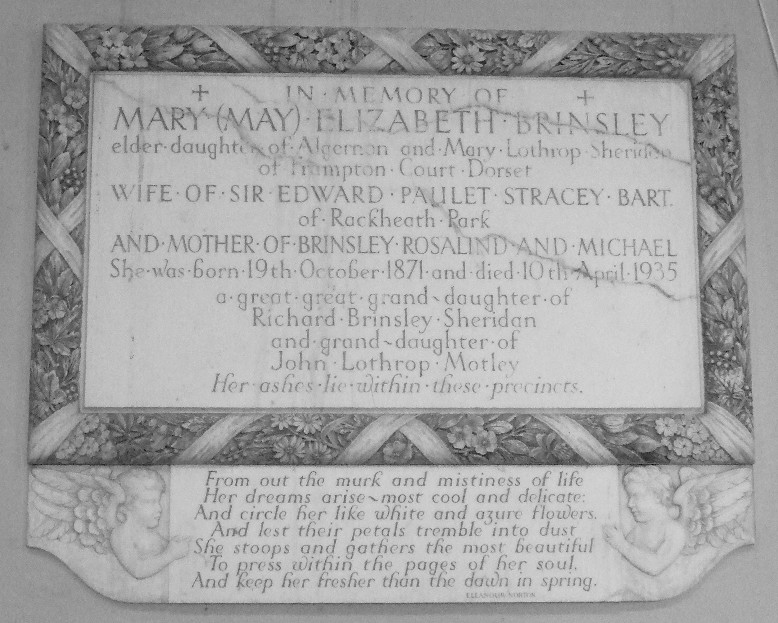
Gerald Hyde Charles Stracey


All Saints - Rackheath

© Godric Godricson

Monday, 4 June 2012

Tombs


His Majesty George VI
1895-1952
Wikipedia
Buried : St. George's Chapel, Windsor Castle
It’s the Diamond jubilee weekend in the UK and its difficult to avoid  Royalty and the Royal family. This blog isn’t interested in Monarchy as such although we do learn about burials and tombs from the experience of historical personalities.

It may seem strange to consider the death and burial of His Majesty George VI at a time of national celebration although this juxtaposition is not a surprise. After all, we live in a culture where the Resurrection is celebrated after a time of reflective mourning and Easter is part of the teachings of the Established Church. The tombs of the famous and infamous still feature in our lives for positive and negative reasons.

We can also compare and contrast a life of service evidenced by His Majesty George VI  and the sometimes dubious ministry of senior clergy. Despite claiming for themselves piety and religious honour clergy around the world have recently come in for criticism for demonstrating venal lives far from the example of  duty evidenced in the life of  George VI. In modern times, even the tombs of senior clergy are considered capable of being used for illegal purposes. Mechelen Cathedral in Belgium experienced the unusual situation whereby the tombs of two Cardinals (Suenens and Van Roey)  were pierced and a camera inserted to see whether there were any hidden documents relating to the Roman Catholic Churches abuse of vulnerable children. The issue of paedophile priests has become such a pressing issue that even the tombs of Cardinals are searched. Eternity and the meaning of eternity is something to be considered and reflected upon as the inscrutable power of the Church is continuously peeled away to reveal what was once the uncomfortable secret of institutional abuse. How far have the clergy strayed from their pathway.

As we consider Royal tombs, we also reflect upon  “Dealings with the Dead- 1852” and how the Sexton views the idea of tombs from an historical perspective. The Sexton who wrote the book is clearly not in favour of burials in Churches and he dislikes the building of tombs in Churchyards, especially in urban areas close to populations. In the 19th century we witness a common sense connection between odour and ‘miasma’ theory or the association of stench with disease. Tombs are bad news.

Thomas Matthews
All Saints - Newton by Castleacre

© Godric Godricson
For the sexton,  writing in 1852, the best way of disposing of a body was to lay it in the Earth where the soil would deal with the stench of decomposition and leave the environment safe.  The option of tombs was not to be endured as  they were associated with disease. The association between stench, disease and the tomb is clear and strong and the book leaves room for no other message.

Despite the words of the Sexton, we experience an affinity between Royalty and tombs. The British have the necropolis of Westminster Abbey and France had Saint Denis in Paris. The Belgian Royal family have the Royal Crypt situated in the church of Notre-Dame de Laeken etc etc etc. There is clearly something  going on in this association of burials and Royalty and it isn’t anything to do with health and hygiene. We have already looked at the association of burials in the Christian context. The cult of death and tombs very much fit into the Christian death cult. Tombs are the world of the dead where sad dirges can be sung and where a death focused religion can have its dark places away from the sun. The mouldy drapes can hang around the coffin and priests can wade through the human dust in another service. The cult of the dead strengthened the message that the closer the body then so much the better and the Royal tombs of Europe are paradoxically close to the people whilst also being separated from the people. The tomb under the Church floor and in front of the altar means that the personality of the deceased is always there as a reminder to the living and the dead live forever in the memory and popular conception. Too strong a message?  well, that could be true although a secondary theme in this posting is a sort of ancestor worship. We witness a sort of ancestor worship with the Stracey family at Rackheath where the family used the parish Church a sort of genealogical chart for some generations before they finally left the areas and ceased to be associated with Rackheath.  

Henry Hardinge Denne Stracey
All Saints - Rackheath

© Godric Godricson
 The parish Church at Rackheath was gradually turned into a funerary chapel. For Royalty, the theme of ancestor worship is so much stronger and rather than a family genealogy we are dealing with the governance of a nation. The illustrious dead form part of national history and Kings and princes are there as markers in time and through the passing of time. Ancestors become  part of a cultic centre where the monuments record the earlier generation and claim the future both in blood and art. The monuments feature as a marker of the place of burial  and mark the passing of  time. So much more for Royalty than for the local land owning family.

Whilst all rich families could own land and perpetuate a dynasty of sorts; the problem with tombs is that they can be opened both for the addition of new bodies and for the stealing of others. The Sexton tells us of the atrocities that can happen even in New England in the increasingly  rational 19th century and its worse when we consider the fate of Royal tombs. Saxon Kings are buried and exhumed only to be boxed and stored in Winchester cathedral to be thrown around in the time of Cromwell’s  Republic. The fate of Cromwell is symptomatic of what happens to leaders that fall out of favour. We find Cromwell being disinterred and ritually executed before being unceremoniously dumped.

His Majesty King James II & VII 
(1633 - 1701)
Wikipedia
James II and VII of England and Scotland was originally buried at the Chapel of St Edmund administered by the English Benedictines at Rue St. Jacques, Paris before being disinterred at the time of the French revolution. So much for the holy precincts of the Church which cannot protect the Royal dead from  the ravages of time and the changing tides of history. The illustrious Stuart Prince is scattered to the four winds and is nowhere to be found. Later Stuart claimants to the throne found their way to the Vatican for burial although they are now subject to the tender mercies of the Roman Catholic Church. I doubt if Royal Stuart tombs will be subject to as much scrutiny as more recent Cardinals. Various Monarchs and Royals have been buried at St George's Chapel, Windsor Castle although even here (and in more modern times) we find that there have been ‘clear outs’ of the vaults with remains re-interred at Frogmore, so much for eternity in one place. If we have learnt anything from the Saxon Monarchs then it is that eternity is a movable feast rather than a fact. The occupants of a tomb hope for immortality although they are at the mercy of the living and the aspirations of the wealthy and sometimes of the nouveau riche.

The Sexton admonishes us against reliance on the alleged security of the tomb and against the storage of the dead above ground. It is clear that such practices are never for the majority and only for a small fraction of the population. It is also clear that tombs leave the dead open to disrespect and violation. They are no guarantee of eternity or of fidelity.

Although this posting has focused on the tomb; the real message of the jubilee weekend is about  the celebration of a long reign completed with honour and dignity.

This blog is also a time to consider the place of ancestry, community memory and monuments to the past. This blog is a space where we reflect on the past and we contemplate the meaning of genealogy, burials and funerals.

William Martin Died 25th January 1767


All Saints - Newton by Castle Acre

© Godric Godricson


Floor tile


Ceramic tile adjacent
to an in Church burial

© Godric Godricson


This beautiful tile represents the more organised flooring found in Norfolk Churches and is immediately adjoining an in Church burial. This is a 19th Century example of flooring being 'tidied up' in the sanctuary area of the Church.

In Church burials

Rustic Church floor - Mid Norfolk

© Godric Godricson


This is a brick floor from a Church in Mid Norfolk. It is representative of many Churches in rural Norfolk that don't have the rich marble flooring of urban and more developed Churches. Rural parishes are exactly that and we can imagine boots and rough shoes clattering over the bricks as people entered and left the Churches. 

Medieval burials in Churches are often covered in the 18th Century by this sort of material as parishes sought to cover up the uneven floors surfaces and make floors more convenient and comfortable

Saturday, 2 June 2012

Alfred Cresswell - West Lexham

Alfred is the son of Edward Cresswell

© Godric Godricson

Edward Cresswell - West Lexham

Edward Cresswell - West Lexham

© Godric Godricson

William Case (1814-1857) - Saint Peter, Dunton


William Case - Saint Peter, Dunton

© Godric Godricson

Birth:
Birthplace:Testerton House, Norfolk
Death:Died in Chinut, India

16th Century monument - Saint Botolph, Trunch


16th Century monument - Saint Botolph, Trunch

© Godric Godricson


Table tomb Saint Botolph - Trunch


Table tomb Saint Botolph - Trunch

© Godric Godricson